Diagnosis guideCrawl Spaces
Crawl Space Mold: Why It Grows, How Serious It Is and How to Get Rid of It
Mold on crawl space joists is a moisture problem first. Find the water, size the job against EPA guidance, clean it safely and keep the space dry.
Crawl space mold is fungal growth on the floor joists, beams, subfloor and insulation under a house with a raised floor. It grows when the crawl space stays damp for weeks at a time, usually from humid outdoor air, bare soil, leaks or poor drainage. The mold itself is a symptom: the real problem is the water. This guide is part of our crawl space guides, where each problem is explained from cause to fix.
If an inspector found mold under your house, or you smell a musty odor in the rooms above, you need to know how serious it is and what to do. You are not alone, and in most cases the problem is fixable once you find the water. In this guide I will explain why crawl space mold grows, how to identify it, how it affects health and the house, how to size the cleanup against EPA guidance, how to remove it safely, what it costs and how to stop it from coming back.
Short answer
Crawl space mold grows when humidity and wood moisture stay high, so the first step is always to find and stop the water. If the moldy area is under about 10 square feet, the EPA says you can usually clean it yourself with detergent, water and an N-95 respirator. Larger areas need a professional with containment. Keep the crawl space below 60% relative humidity afterward, or the mold returns.
Small and dry
Under 10 sq ft
A few patches on sound wood. Fix the moisture, clean it yourself with the right protection.
Professional cleanup
10 to 100 sq ft
Mold across several joists or wet insulation. Hire a remediator who uses containment.
Major job
Over 100 sq ft or soft wood
Widespread growth, rotting framing or musty air in the house. Remediation plus a structural check.
What Is Crawl Space Mold?
Mold is a fungus that feeds on organic material such as wood, paper facing on insulation and dust. Its spores are in all outdoor and indoor air, so they land on crawl space framing all the time. They only grow into visible colonies when the surface stays damp. That is why crawl space mold usually appears on the joists and subfloor first, especially on the cooler side near vents and ducts.
Mold and wood rot are related but different. Surface mold stains wood without weakening it much. Wood-decay fungi break down the wood itself. USDA Forest Products Laboratory research found that wood decays above 30% moisture content and does not decay below 20%, so the same damp conditions that grow mold can also lead to rot if they continue.
What Causes Mold in a Crawl Space?
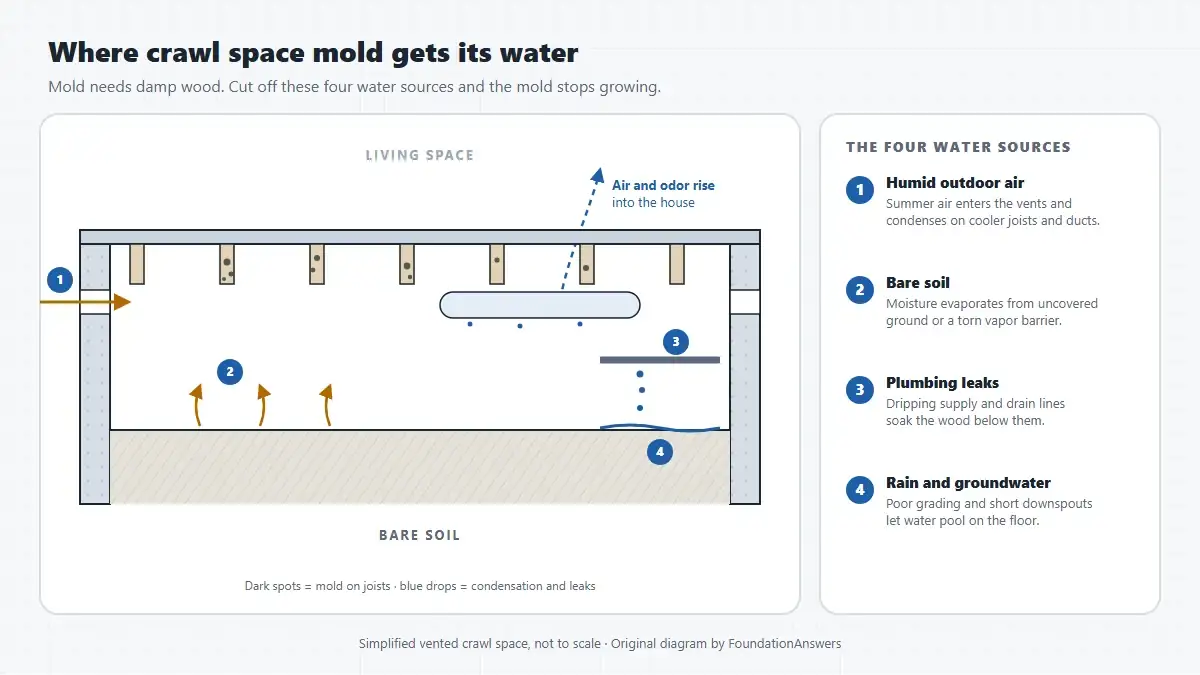
Every case of crawl space mold comes back to moisture. Below I am sharing the four sources, in the order they are most common.
- Humid outdoor air: In summer, warm, humid air flows in through foundation vents and meets cooler wood and ducts. A field study by Advanced Energy for the US Department of Energy recorded vented crawl spaces often above 80% relative humidity in summer.
- Bare or poorly covered soil: Ground moisture evaporates into the space all year. A missing, torn or loose vapor barrier lets it through.
- Plumbing leaks: Supply lines, drain lines and HVAC condensate lines drip onto the framing below them.
- Rain and groundwater: Soil that slopes toward the house, short downspouts and a high water table let water pool on the crawl space floor.
The EPA advises keeping indoor relative humidity below 60%, ideally between 30% and 50%. The glossary entry on relative humidity explains what that reading means and how to measure it.
How to Identify Crawl Space Mold
You can usually confirm crawl space mold by looking and smelling. Below I am explaining the common signs and what they point to, in a table.
| What you notice | Where | What it usually means |
|---|---|---|
| Fuzzy white, gray, green or black spots | Joists, beams, subfloor | Active mold growth on damp wood |
| Musty, earthy smell | Crawl space and rooms above | Mold or damp materials; crawl space air reaching the house |
| Dark staining with soft wood | Sill plates, joist ends, subfloor | Possible rot as well as mold; probe with a screwdriver |
| Sagging, damp insulation | Between the joists | Wet insulation holding moisture against the wood |
| Water droplets on ducts or pipes | Under the floor in summer | Condensation from humid air |
| White crystals on masonry | Foundation walls and piers | Often efflorescence, a mineral salt, not mold |
As the table shows, most signs point back to one cause: damp wood. The exception is white crystals on masonry, which are usually mineral salts, not mold.
You do not need a lab test in most cases. The EPA states that sampling is usually unnecessary when mold is visible, and that no EPA or other federal limits exist for mold or spores. The CDC also says you do not need to know the type of mold, because every type should be removed.

Is Crawl Space Mold Dangerous?
Crawl space mold affects both the people in the house and the house itself. Below I am sharing the main risks.
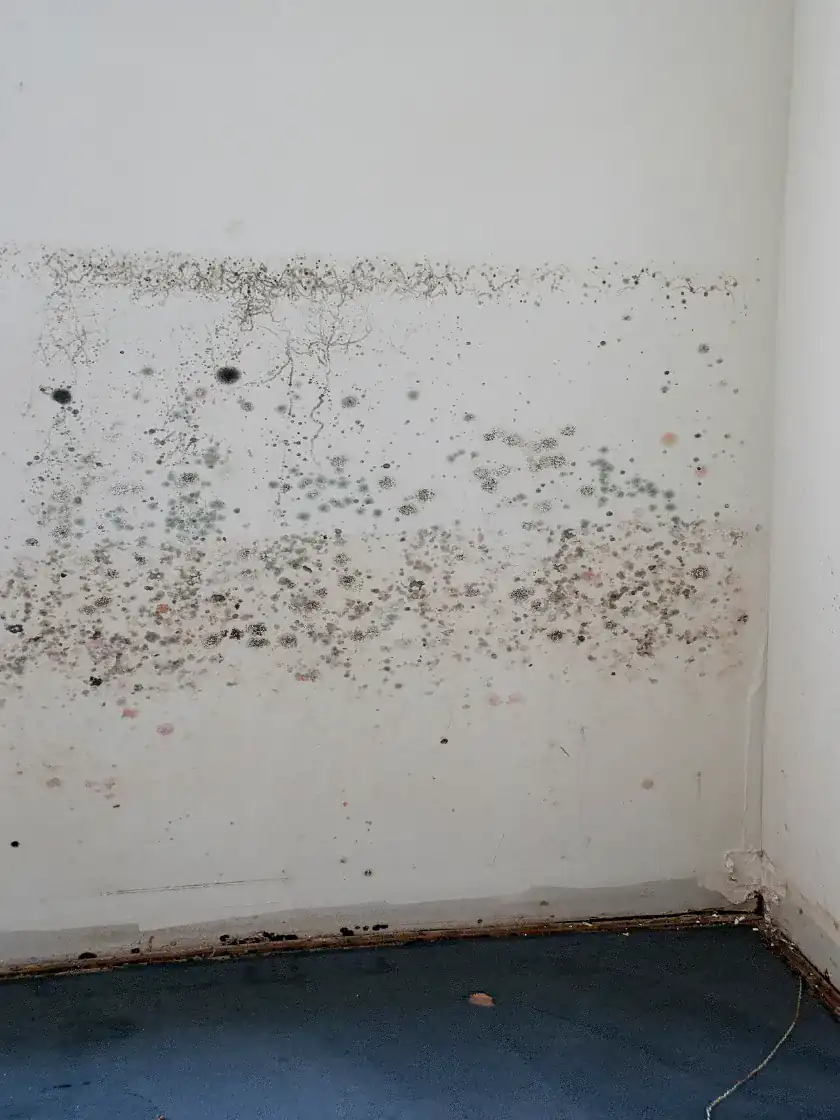
- Allergy and breathing symptoms: The CDC lists a stuffy nose, sore throat, coughing or wheezing, burning eyes and skin rash. People with asthma or mold allergies can react severely.
- Higher-risk groups: The CDC notes that people with weakened immune systems or chronic lung disease can develop lung infections from mold.
- Air reaching the house: Warm air rising through the house pulls air up from the crawl space through gaps in the floor, carrying odor and spores with it.
- Damage to the structure: Long-term damp conditions that feed mold also feed wood rot, which weakens joists, sill plates and subfloors.
So, Can You Remove Crawl Space Mold Yourself?
The EPA bases its cleanup advice on the size of the moldy area. Measure it before you decide: a single patch of about 3 feet by 3 feet equals 9 square feet.
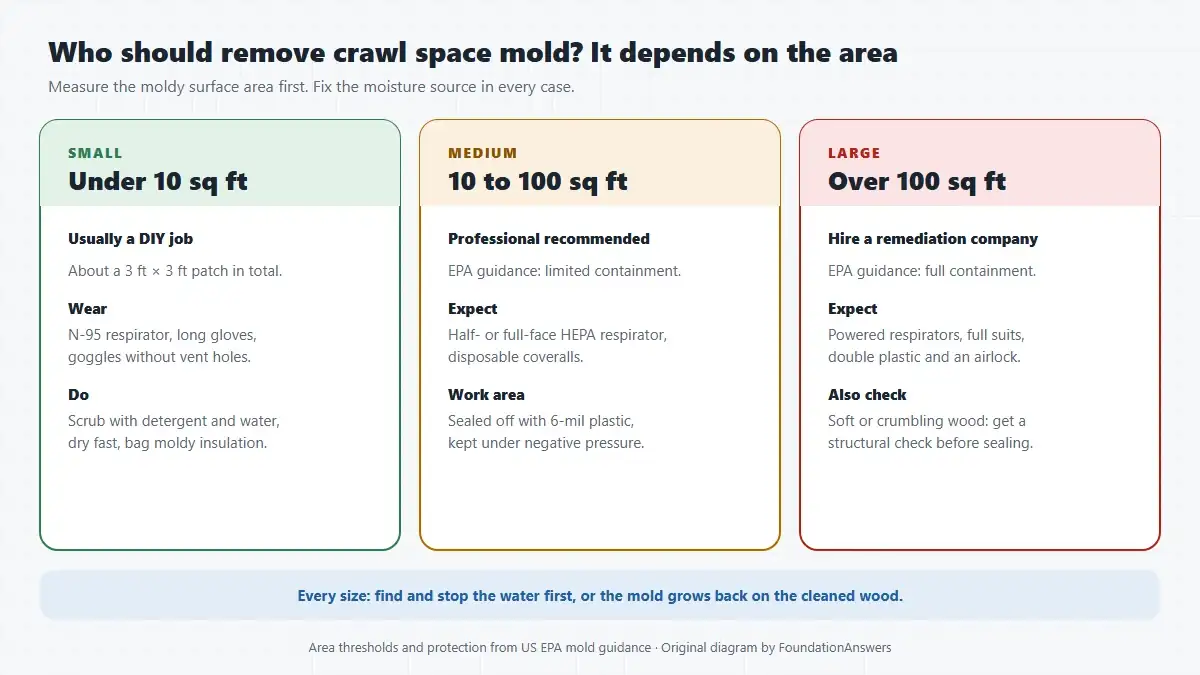
Below I am explaining the size categories and typical costs in a table. Costs come from Fixr's mold remediation data, updated August 2025.
| Moldy area | Who does it | Protection and containment | Typical cost |
|---|---|---|---|
| Under 10 sq ft | Homeowner | N-95 respirator, long gloves, unvented goggles | Supplies only |
| 10 to 100 sq ft | Remediation contractor | HEPA respirator, coveralls, plastic sheeting under negative pressure | About $500–$2,000 for a crawl space |
| Over 100 sq ft | Remediation contractor | Full containment with an airlock, powered respirators | $10–$30 per sq ft; $3,500 average for mold jobs |
| Mold testing (optional) | Inspector | Rarely needed when mold is visible | $450–$800 |
As the table shows, the size of the moldy area decides who does the work and how much protection the job needs, and the cost rises with it.
Use this formula to estimate a larger job before you collect quotes:
Estimated cleanup cost = moldy area (sq ft) × $10 to $30 per sq ft
Example: Mold across 120 square feet of joists and subfloor works out to roughly 120 × $10–$30 = $1,200–$3,600 for the cleanup alone. Add the moisture fix on top, because a quote without one only pays to clean mold that will grow back.
How to Remove Crawl Space Mold Step by Step
If your moldy area is small and the wood is sound, you can follow these steps. Below I am sharing them in order.
- Stop the water: Fix leaks, extend downspouts and correct grading first. Cleaning before this wastes the work.
- Gear up: Wear an N-95 respirator that fits, gloves that reach the middle of the forearm, goggles without vent holes and old clothes you can wash.
- Remove wet insulation: Bag moldy or soaked insulation in heavy plastic bags inside the crawl space. The EPA notes that absorbent materials may have to be thrown away.
- Scrub the wood: Clean mold off the framing with detergent and water, using a stiff brush. Do not dry-brush or sand without containment.
- Dry it fast: Use fans or a dehumidifier so the wood dries quickly. The EPA advises drying water-damaged materials within 24 to 48 hours.
- Check the moisture: Confirm the wood reads below 20% moisture content with a pin meter before you add new insulation or a liner.
- Keep it dry: Cover the soil with a sealed vapor barrier and control humidity, as explained below.
Avoid bleach shortcuts. The EPA does not recommend bleach or other biocides as a routine part of mold cleanup, and it warns never to mix bleach with cleaners that contain ammonia. Do not paint or caulk over mold either: the EPA notes paint applied over moldy surfaces is likely to peel.
How to Prevent Crawl Space Mold From Coming Back
Prevention is the same job as fixing the cause. Below I am sharing the steps, from cheapest to most complete.
- Manage rain water: Extend downspouts away from the house and slope the soil away from the walls.
- Cover the ground: Lay a sealed polyethylene vapor barrier over all exposed soil, with overlapping, taped seams.
- Fix leaks quickly: Check plumbing and HVAC condensate lines in the crawl space once a year.
- Measure humidity: Leave a hygrometer in the crawl space and aim for below 60% relative humidity.
- Seal and dry the space: In humid climates, closing the vents and adding a dehumidifier or conditioned air keeps the space dry year-round.
The last step is crawl space encapsulation. Read our guide on whether encapsulating a crawl space is worth it before you accept a quote, because many crawl spaces only need the cheaper first steps.

Common Mistakes to Avoid With Crawl Space Mold
- Treating the mold, not the moisture: Sprays and fogging kill some surface growth but leave the water source in place.
- Sealing over damp wood: A liner or spray foam over wet, moldy framing traps the problem.
- Paying for tests you do not need: Visible mold needs removal whatever the species, so testing rarely changes the plan.
- Working without protection: Disturbing mold in a tight space raises spore levels. Wear the right respirator.
- Ignoring soft wood: If a screwdriver sinks into joists or sill plates, the job includes structural repair, not just cleaning.
- Hiring the same company to test, clean and certify: An independent check gives you a clearer picture of what was done.
Conclusion
Crawl space mold is a moisture problem that shows up on wood. Find the water source first, measure the moldy area, and follow EPA guidance: small areas are a careful DIY job, larger ones need a professional with containment. Dry the wood, cover the soil and keep the humidity below 60%, and the mold will not come back. For more help with foundations and the space beneath your floors, browse our independent answers about crawl spaces, damp and mold.
Frequently Asked Questions
-
How serious is mold in a crawl space?
It depends on how much there is and whether the wood is still sound. A few spots on joists in a damp crawl space are common and fixable once you dry the space. Widespread growth, soft or crumbling wood, or musty air in the house is more serious. Treat any crawl space mold as a sign of a moisture problem that needs fixing.
-
Will homeowners insurance cover mold in a crawl space?
Usually only when the mold follows a sudden, covered event, such as a burst pipe or a failed water heater. Mold from long-term humidity, slow leaks or poor maintenance is normally excluded. Many policies also cap mold payouts; Policygenius reported a typical cap of $10,000. Check your own policy's mold and water damage wording before you start work.
-
How much does it cost to remove mold from a crawl space?
Fixr's cost data puts crawl space mold removal at about $500 to $2,000, with larger mold jobs in a home averaging around $3,500 and running $10 to $30 per square foot. The price rises with the area, insulation that has to be removed, damaged wood and the moisture fixes that go with the cleanup, such as a vapor barrier or dehumidifier.
-
Is white mold in a crawl space dangerous?
White growth on joists is usually mold and needs the same moisture fix and cleanup as dark mold. Color does not tell you how risky a mold is, and the CDC says you do not need to know the type to remove it. White crystals on concrete or block walls are often efflorescence, a mineral salt that dissolves in water, not mold.
-
Should I buy a house with mold in the crawl space?
Often yes, if you price the fix. Ask your inspector how much area is affected, whether the wood is soft, and what is causing the moisture. Get a quote for cleanup plus the moisture fix, such as a vapor barrier, drainage or encapsulation, and use it to negotiate. Walk away or get a structural opinion if the framing is rotting.
-
Can you encapsulate a crawl space that has mold?
Not before the mold is cleaned and the wood is dry. Sealing a liner over active mold traps it in a damp space. The usual order is: fix leaks and drainage, remove moldy insulation, clean the framing, let the wood dry below about 20% moisture content, then install the liner, seal the vents and add drying.
Sources and Standards
- US EPA, A brief guide to mold, moisture and your home, updated February 2026.
- US EPA, Mold remediation in schools and commercial buildings, chapter 3, updated April 2026.
- CDC, About mold and your health, September 2024.
- Morris, P. I. and Winandy, J. E., USDA Forest Service, Forest Products Laboratory, Limiting conditions for decay in wood systems, 2002.
- Advanced Energy, closed crawl space performance study (US Department of Energy, OSTI record 850459).
- Fixr, Mold remediation cost, updated August 2025.
- Policygenius, Does homeowners insurance cover mold?
- Health Canada, Take action: getting rid of mould (archived).
This guide is general information and does not replace an on-site inspection by a qualified professional. Read our disclaimer.