Diagnosis guideSettling & Subsidence
House Settling Cracks: How to Tell Normal Cracks From Warning Signs
Almost every house cracks a little. The shape, the width and whether the crack keeps growing tell you if it is drying lumber or a foundation that is still moving.
House settling cracks are cracks in walls, ceilings, brick or concrete that appear as a house adjusts to its foundation, its soil and the drying of its building materials. Most are thin and harmless: lumber shrinks, concrete and plaster dry, and the soil under the footings compresses a little under the weight of the house. A few are signs that part of the house is still moving. This guide is part of our settling and subsidence hub, which explains how much movement is normal.
If you just noticed a crack above a door, a line along the ceiling or a jagged crack in the brick, you are not alone in wondering whether the house is failing. NAHB reports that cracks are the number one concern homeowners raise with builders' warranty teams about structure, and that the vast majority are cosmetic. In this guide I will explain what causes settling cracks, how to read the shape and width of a crack, which cracks are normal and which are warning signs, how to monitor a crack, and what the repairs cost.
Short answer
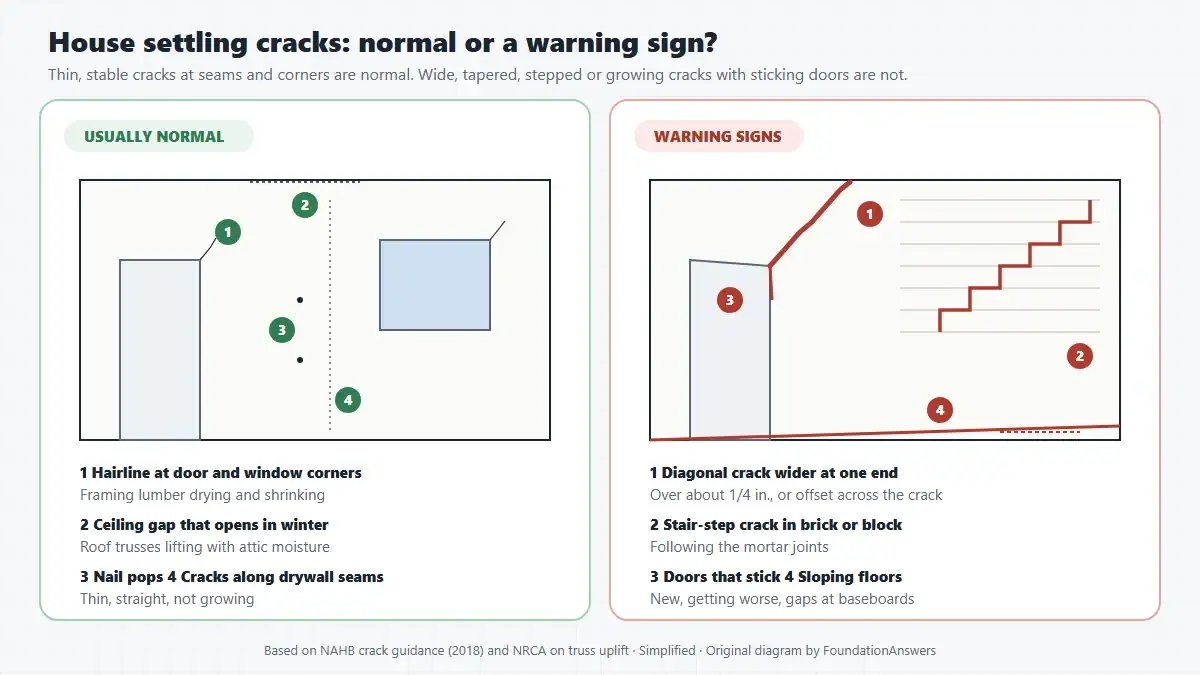
Thin cracks at drywall seams, door and window corners, and a ceiling gap that opens in winter are normal; they come from drying lumber, seasonal movement and truss uplift. A crack is a warning sign when it is wider than about 1/4 inch, wider at one end, offset, stair-stepped through brick or block, or still growing, especially with sticking doors or sloping floors. Mark it, measure it and recheck over a season.
Normal
Hairline and stable
Thin cracks at seams and corners that do not grow. Patch when you repaint.
Monitor
Up to about 1/4 inch
Mark the ends and width with the date and recheck over the seasons.
Get it checked
Wide, tapered or growing
Offset or stepped cracks, sticking doors, sloping floors. Call an engineer.
What Causes House Settling Cracks?
Most "settling" cracks are not caused by the foundation at all. NAHB's guidance on the common crack lists several everyday causes. Below I am sharing them.
- Drying framing lumber: NAHB notes that kiln-dried lumber arrives at about 12 to 15% moisture content and settles to about 10 to 12% inside a home. As a rule of thumb, a 4% moisture change causes about a 1% change in size across the grain, so joists and plates shrink and the drywall on them cracks.
- Curing concrete, mortar and plaster: These materials lose water as they dry and shrink, which leaves fine cracks.
- Temperature changes: NAHB gives the example of a 100-foot interior drywall wall moving about 0.05 inch with a 15°F change, and an exterior concrete wall of the same length moving about 0.50 inch with a 75°F change.
- Normal deflection: Joists, beams, trusses and lintels bend slightly under load, and finishes over them crack at weak points.
- Foundation movement: All foundations on soil move a little as the soil adjusts to the load and to moisture changes. NAHB notes that conventional spread footings are designed to tolerate movement of up to about 1 inch.
When movement is uneven, one part of the house drops more than another. That is differential settlement, and it produces the diagonal and stepped cracks that need attention.
Example: Suppose a new house has floor joists 9 1/4 inches deep that dry from about 15% to about 11% moisture content in the first heating season. Using NAHB's rule of thumb, a 4% drop shrinks each joist about 1% in depth, or roughly 3/32 inch. Add the plates and the second-floor joists, and the framing between floors can drop enough to crack drywall at stairwells and around doors, with no foundation problem at all.
How to Read a Settling Crack
The shape, location and width of a crack tell you most of what you need to know. Below I am sharing the common crack types in a table.
| Crack type | Typical cause | Usually means |
|---|---|---|
| Hairline at a drywall seam or nail pop | Lumber shrinkage, normal deflection | Cosmetic |
| Thin diagonal at a door or window corner | Stress concentrates at the corner as framing moves | Cosmetic if thin and stable |
| Gap where ceiling meets wall, worse in winter | Truss uplift | Cosmetic and seasonal |
| Thin vertical crack in a poured basement wall | Concrete shrinkage | Cosmetic; seal if it leaks |
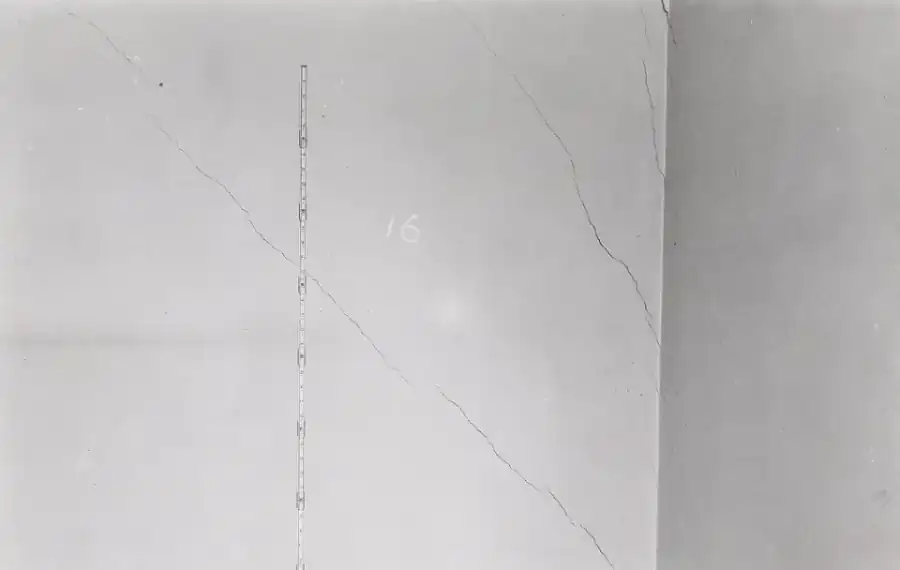
| Diagonal crack wider at one end | Differential settlement or heave | Warning sign; monitor or get checked |
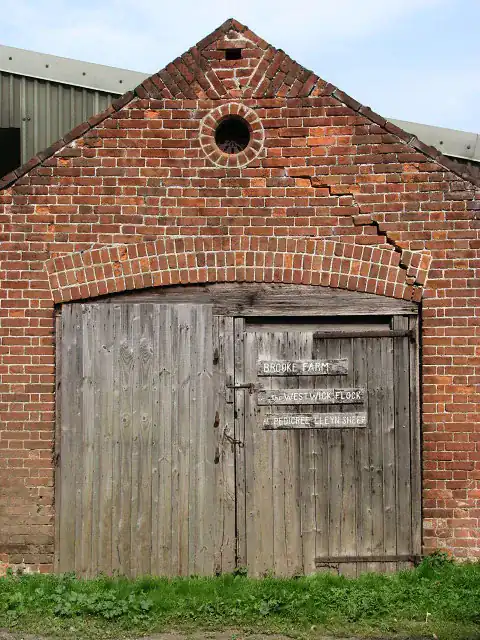
| Stair-step crack in brick or block | Uneven settlement or soil pressure | Warning sign; get checked |
| Horizontal crack in a basement wall | Soil pressure pushing the wall | Structural; engineer |
| Crack with one side offset | Movement across the crack | Structural; engineer |
As the table shows, thin cracks at seams, corners and the ceiling line are the normal kind. The ones to take seriously are tapered, stepped, horizontal or offset, because they show that the structure under the finish has moved. Our foundation cracks guide covers cracks in the foundation walls and slab in more detail.

How Wide Is Too Wide?
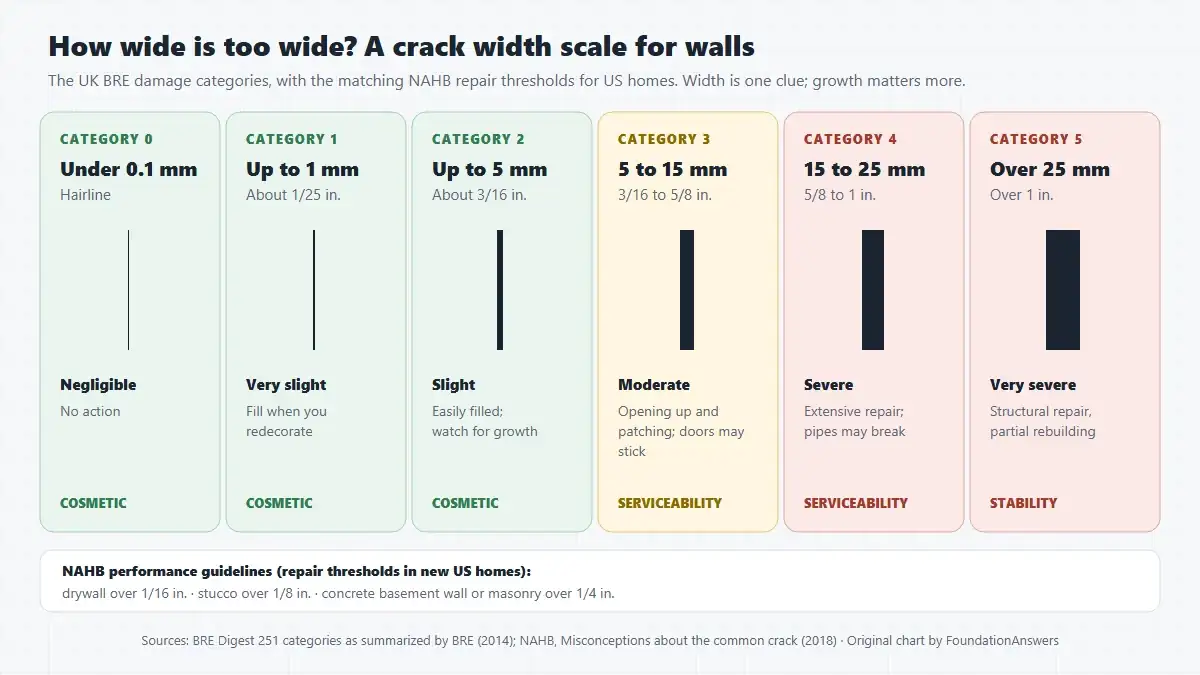
There is no single universal standard for cracks, as NAHB points out, but two widely used references agree on the general picture. Below I am sharing the UK Building Research Establishment damage categories in a table.
| Category | Typical crack width | What it means |
|---|---|---|
| 0, negligible | Under about 0.1 mm | Hairline; no action |
| 1, very slight | Up to about 1 mm | Fill when you redecorate |
| 2, slight | Up to about 5 mm (3/16 in.) | Easily filled |
| 3, moderate | About 5 to 15 mm | Opening up and patching; doors and windows may stick |
| 4, severe | About 15 to 25 mm | Extensive repair |
| 5, very severe | Over about 25 mm (1 in.) | Structural repair |
As the table shows, BRE treats categories 0 to 2, with cracks up to about 5 mm, as aesthetic issues that need only redecoration. Categories 3 and 4 affect how doors, windows and weatherproofing work, and category 5 is a stability issue. For new US homes, NAHB's performance guidelines treat drywall cracks over 1/16 inch and masonry cracks over 1/4 inch as items for repair. BRE also notes that whether a crack is widening over time can change its category, so width alone is never the whole story.
Warning Signs That It Is More Than Settling
NAHB lists the indications of a potential structural crack. Below I am sharing them in plain terms.
- Large cracks and separations: Cracks wide enough to fit a coin, or walls pulling away from ceilings, floors or each other.
- Floors that slope or bounce: A ball that rolls, or a floor that dips more each year.
- Doors and windows that stop working: New sticking, gaps at the top of one side, or latches that no longer line up.
- Walls that lean or bow: Especially basement walls pushed inward.
- Cracks with vertical displacement: One side of the crack higher than the other.
- Horizontal basement wall cracks: Especially with bowing or leaning.

Why the Ceiling Cracks Every Winter
A gap that opens along the top of interior walls each winter and closes in summer is usually truss uplift, not settling. NRCA's Professional Roofing explains that the top members of roof trusses, out in the cold attic, take on moisture and swell, while the bottom members, buried in insulation, stay warm and dry. The truss arches up and lifts the ceiling off the walls, with the worst gaps near the middle of the house.
NRCA describes truss uplift as more of a cosmetic problem than a structural one. Keeping attic moisture low limits it, and builders hide it by fastening ceiling drywall at least 16 inches from interior walls, or by using crown molding that is attached to the ceiling only, so it moves with the trusses.
How to Monitor a Settling Crack
A single look cannot tell you whether a crack is still moving. Below I am sharing a simple routine that can.
- Mark the ends: Draw a short pencil line across each end of the crack and write the date beside it.
- Measure the width: Use a crack-width card or a ruler at the widest point, and record it.
- Photograph it: Take a photo with a ruler or coin in the frame from the same spot each time.
- Recheck each season: Look every one to three months for at least a year, because many cracks open and close with the seasons.
- Watch the doors and floors: Note any new sticking or sloping at the same time.
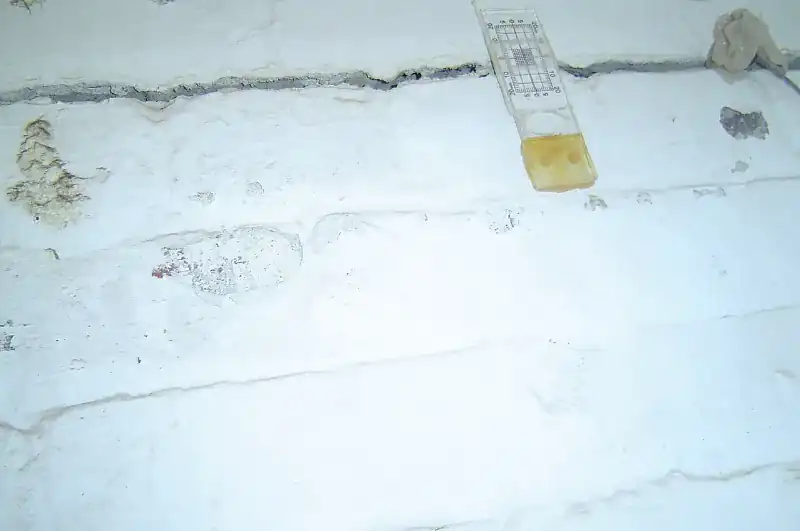

A crack that stays within its pencil marks for a year is stable, and patching it is routine. A crack that grows past the marks, or new cracks that appear nearby, mean the cause is still active.
Settling Crack Repair Cost
Repair cost depends on whether you are fixing a finish or a foundation. Below I am sharing typical 2026 prices in a table.
| Repair | Typical cost | Source |
|---|---|---|
| Drywall crack repair, per repair | $297–$472 | Homewyse, May 2026 |
| Foundation crack filling | $250–$800 | This Old House, Oct 2026 |
| Structural engineer's assessment | $500–$1,000 | This Old House, Oct 2026 |
| Foundation repair, average | $5,179 ($2,224–$8,134) | This Old House, Oct 2026 |
| Piering, per pier | $1,000–$3,000 | This Old House, Oct 2026 |
As the table shows, cosmetic crack repair costs a few hundred dollars, while foundation repair runs into thousands. An engineer's assessment at $500 to $1,000 is cheap insurance before you pay for either, because it tells you which one you need.
So, What Should You Do About Your Cracks?
The right next step depends on what you see.
- If the cracks are hairline at seams and corners: Patch them when you repaint. Nothing else is needed.
- If a ceiling gap opens every winter: Treat it as truss uplift. Reduce attic moisture and hide it with ceiling-mounted molding.
- If you live in a house under two years old: Log the cracks for the builder's warranty and compare them with NAHB's thresholds.
- If a crack is up to about 1/4 inch and you are unsure: Mark and measure it, and recheck over the seasons.
- If a crack is tapered, stepped, offset or growing, or doors stick: Get a structural engineer's assessment before any cosmetic repair.
- If you are buying the house: Ask the seller when the cracks appeared and whether they have been patched before; repeated patching of the same crack means it keeps moving.
Common Mistakes to Avoid With Settling Cracks
- Patching before you know it is stable: Fresh filler hides growth that an engineer needs to see.
- Judging by width alone: A thin crack that keeps growing matters more than a wider one that stopped years ago.
- Blaming every crack on the foundation: Drying lumber and truss uplift cause most interior cracks.
- Ignoring the water: Leaks, downspouts and drought are the usual causes of new movement in an older house.
- Paying for piers before an assessment: A contractor who sells piers is not the right person to decide whether you need them.
Conclusion
House settling cracks are usually thin, stable cracks from drying lumber, curing materials, temperature swings and seasonal truss uplift. A crack becomes a warning sign when it is wider than about 1/4 inch, tapered, offset, stair-stepped or growing, especially with sticking doors and sloping floors. Mark, measure and photograph a crack, recheck it over the seasons, and call a structural engineer before you pay for foundation work. For more help, browse our engineer-checked help with cracks, settling and sticking doors.
Frequently Asked Questions
-
When should I be concerned about house settling cracks?
Be concerned when a crack is wider than about 1/4 inch, wider at one end than the other, offset so one side sticks out, stair-stepped through brick or block, or still growing. Doors and windows that start to stick, floors that slope more over time and gaps opening at baseboards are other warning signs. NAHB lists these as indications of a potential structural crack.
-
Can a house still be settling after 20 years?
Not from its original settling, which is long finished by then. New cracks in an older house usually have a new cause: a plumbing leak, poor drainage, a drought that shrinks clay soil, tree roots, or a remodel that added load. Find and fix that cause. Seasonal ceiling gaps and fine cracks that open and close with the weather are normal at any age.
-
How do you fix cracks from house settling?
Fix the cause first, then the crack. Hairline drywall cracks are cut open slightly, taped and refinished, which Homewyse puts at about $297 to $472 per repair in 2026. Recurring ceiling gaps from truss uplift are hidden with molding fastened to the ceiling only. Cracks from ongoing foundation movement need the foundation assessed and repaired before cosmetic work.
-
How can I tell house settling from a foundation problem?
Settling cracks are thin, straight or slightly jagged, and they stop growing. Foundation problems show cracks that widen over months, taper wider at one end, step through masonry, or come with doors that stick and floors that slope. Mark the crack ends and width with the date and check again over a season.
-
Are cracks in a new house normal?
Yes, within limits. NAHB says builders can expect cosmetic cracks in every new home, mainly because framing lumber dries and shrinks during the first year and concrete, mortar and plaster shrink as they cure. NAHB's performance guidelines treat drywall cracks over 1/16 inch and masonry cracks over 1/4 inch as items for repair.
-
Why does the crack between my ceiling and wall open every winter?
That is usually truss uplift. In winter, the top members of roof trusses in a cold attic take on moisture and expand while the bottom members stay warm and dry, so the trusses arch up and lift the ceiling off interior walls. NRCA describes it as more of a cosmetic problem than a structural one.
Sources and Standards
- National Association of Home Builders, Construction Liability and Risk Management Committee, W. Keaveny, PE, Misconceptions about the common crack, January 2018.
- Building Research Establishment, Assessing cracks in houses (BRE Digest 251 categories), 2014.
- Hamilton, L. J., NRCA Professional Roofing, Alleviating truss uplift, February 2008.
- Homewyse, Cost to repair drywall, May 2026.
- This Old House, Foundation repair cost, updated October 2026.
This guide is general information and does not replace an on-site inspection by a qualified professional. Read our disclaimer.