Cost guideBasement Water
Basement Waterproofing Cost: 2026 Prices by Size, Method and Basement Type
Two national price guides, every method priced, a simple formula for the drain system, and the cheap outside fixes to try before you pay for a full system.
Basement waterproofing cost is the total price of keeping groundwater out of your basement, or of collecting it and pumping it away once it gets in. Most homeowners pay between $3,000 and $10,000, but a full exterior job can pass $20,000, and a simple sealant job can stay near $1,000. This guide is part of our basement water hub, where every leak is traced to its source before any repair is priced.
If you have a waterproofing quote in hand and the number surprised you, you are not alone. Two quotes for the same basement can differ by more than $10,000, because one contractor seals the walls and another digs around the whole house. In this guide I will explain what basement waterproofing costs by size and by method, why the two big national price guides disagree, how to estimate a drain system with a simple formula, which cheap outside fixes to try first, and how to check a quote line by line.
Short answer
Fixr's February 2026 data puts basement waterproofing at $5,000 on average, with most jobs between $3,000 and $10,000, or $3 to $10 per square foot. This Old House puts a full system for a 1,000 sq ft basement at about $12,447 to $14,833. Interior methods average about $3,000; exterior methods start around $7,000.
Low end
Under $3,000
Gutters, downspout extensions, regrading, crack injection or waterproof paint for light damp.
Typical
$3,000 to $10,000
An interior perimeter drain with a sump pump on part or all of an average basement.
High end
Over $10,000
Full interior systems on large basements, or excavation and an exterior membrane.
What Does Basement Waterproofing Cost in 2026?
Fixr, updated in February 2026, puts the national average at $5,000. Most homeowners pay $3,000 to $10,000, and large or complex jobs reach $20,000. Per square foot, Fixr gives $3 to $10 for waterproofing and $3 to $6 for damp proofing, which is a lighter coating that resists moisture but not water under pressure.
This Old House, updated in March 2026, uses Homewyse and Angi data and gives a higher figure: about $13,640 on average for a 1,000 sq ft basement. It prices interior methods at about $2,000 to $6,000, exterior methods at about $7,000 to $15,000, and both together at about $8,000 to $18,000. Pros charge about $200 an hour for labor, according to both guides.
Basement Waterproofing Cost by Size
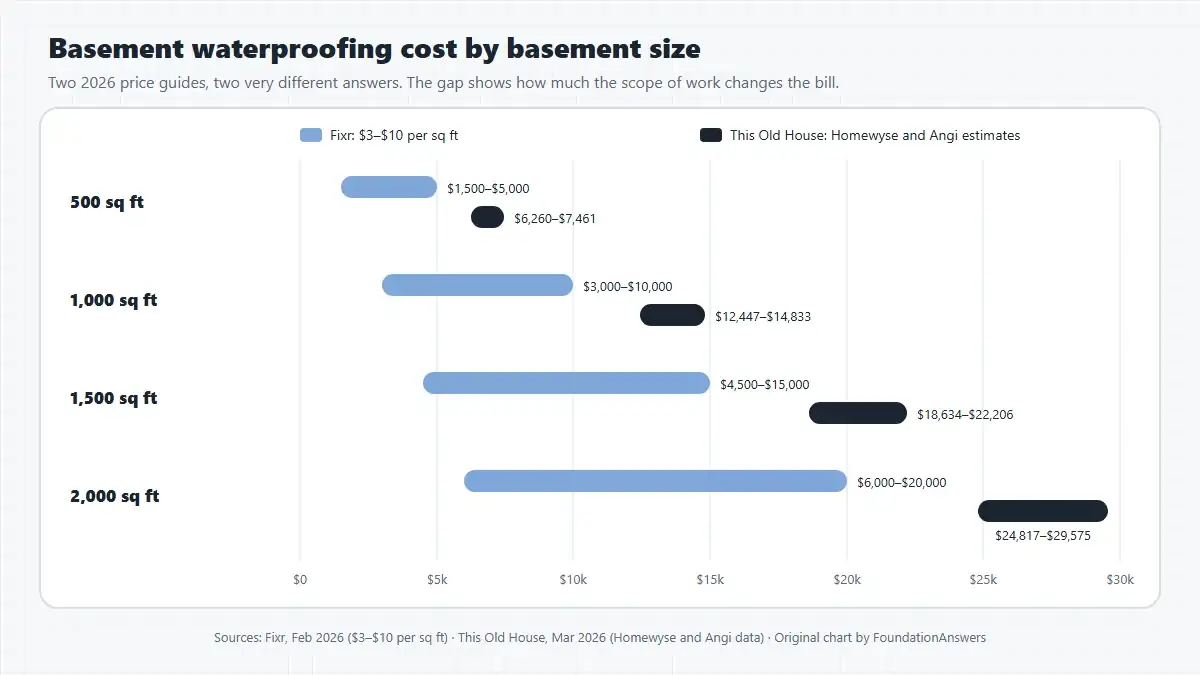
Size is the first number most people search for. Below I am sharing the cost for common basement sizes from both 2026 price guides in a table.
| Basement size | Fixr ($3–$10 per sq ft) | This Old House |
|---|---|---|
| 500 sq ft | $1,500–$5,000 | $6,260–$7,461 |
| 1,000 sq ft | $3,000–$10,000 | $12,447–$14,833 |
| 1,500 sq ft | $4,500–$15,000 | $18,634–$22,206 |
| 2,000 sq ft | $6,000–$20,000 | $24,817–$29,575 |
As the table shows, This Old House's figures sit at or above the top of Fixr's range for every size. The gap is not an error. A per-square-foot average mixes small jobs, such as one crack injection or a coat of sealant, with full drain systems, while the higher estimate assumes a complete system. Your own price lands in one band or the other depending on the method your basement needs.
Basement Waterproofing Cost by Method
A fair quote names the method, because the method sets most of the price. Below I am explaining the typical price of each method in a table, so you can match it against your quote.
| Method | Where | Typical cost | What it does |
|---|---|---|---|
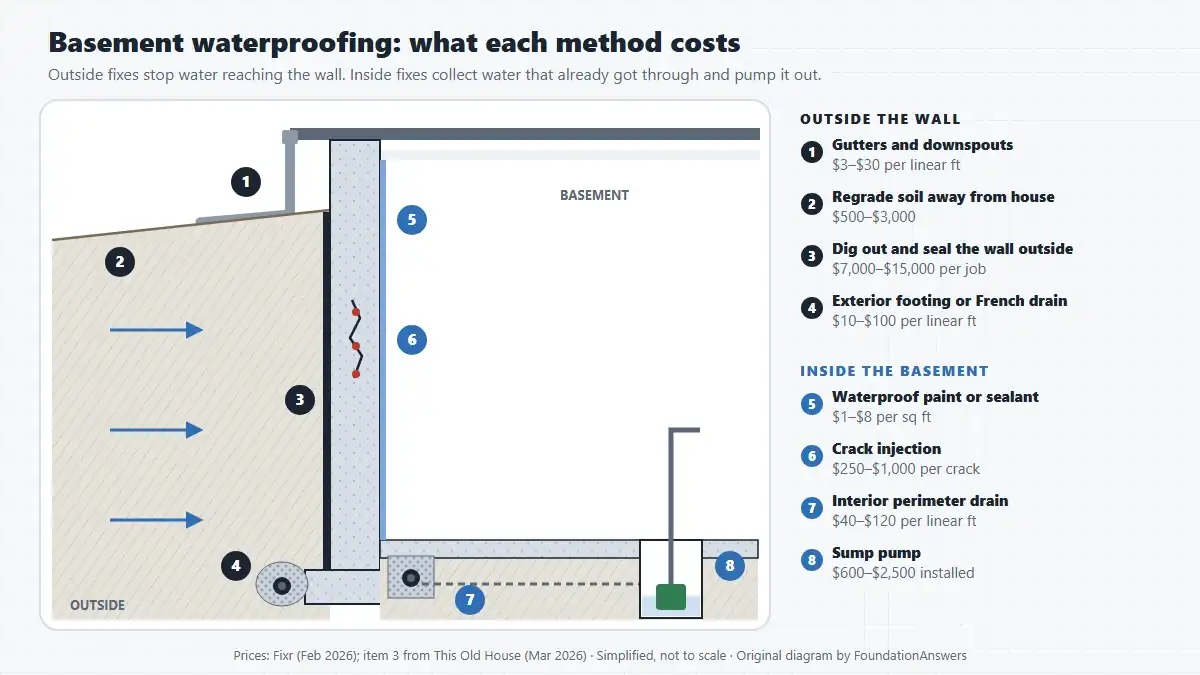
| Gutters and downspouts | Outside | $3–$30 per linear ft | Carries roof water away from the wall |
| Regrading soil | Outside | $500–$3,000 | Slopes the ground away from the house |
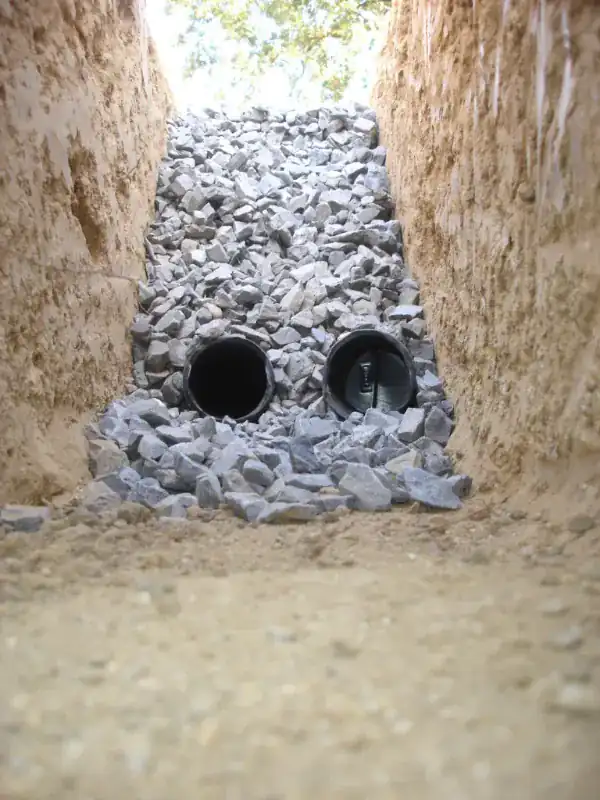
| French drain | Outside | $10–$100 per linear ft | Collects groundwater in a gravel trench and pipe |
| Bentonite clay | Outside | $2–$5 per sq ft | Swells to seal the outside of the wall |
| Excavation and exterior membrane | Outside | $7,000–$15,000 per job | Stops water before it reaches the wall |
| Waterproof paint or sealant | Inside | $1–$8 per sq ft | Handles light damp only; needs recoating |
| Epoxy crack injection | Inside | $250–$1,000 per crack | Seals one leaking crack |
| Interior perimeter drain | Inside | $40–$120 per linear ft | Collects water at the wall-floor joint |
| Sump pump | Inside | $600–$2,500 | Pumps collected water out of the house |
| Vapor barrier | Inside | $1,500–$4,000 | Keeps wall moisture away from finishes |
| Dehumidifier | Inside | $1,000–$2,800 | Controls humidity, not leaks |
As the table shows, the outside fixes for surface water are the cheapest lines, and the two drain systems are where the money goes. Excavation sits at the top because a crew has to dig down to the footing along every wall it treats. Prices come from Fixr (February 2026), except the excavation line, which comes from This Old House (March 2026). This Old House prices epoxy injection higher, at $800 to $1,500 per crack, so check which figure your quote sits near.
Interior vs Exterior Basement Waterproofing Cost
The biggest decision on any quote is whether to work inside or outside the wall. The two approaches solve the problem in different ways.
- Interior drainage: A crew cuts a strip of floor along the walls, lays a perforated pipe in gravel and runs it to a sump pump. Water still enters the wall, but the system relieves the hydrostatic pressure at the floor edge and pumps the water out. This Old House puts interior methods at about $2,000 to $6,000, and Fixr prices the drain at $40 to $120 per linear foot.
- Exterior waterproofing: A crew digs down to the footing, cleans the wall, applies a membrane and often adds a footing drain. Water never reaches the wall face. This Old House puts exterior methods at about $7,000 to $15,000, before landscaping, decks or driveways have to be moved and replaced.
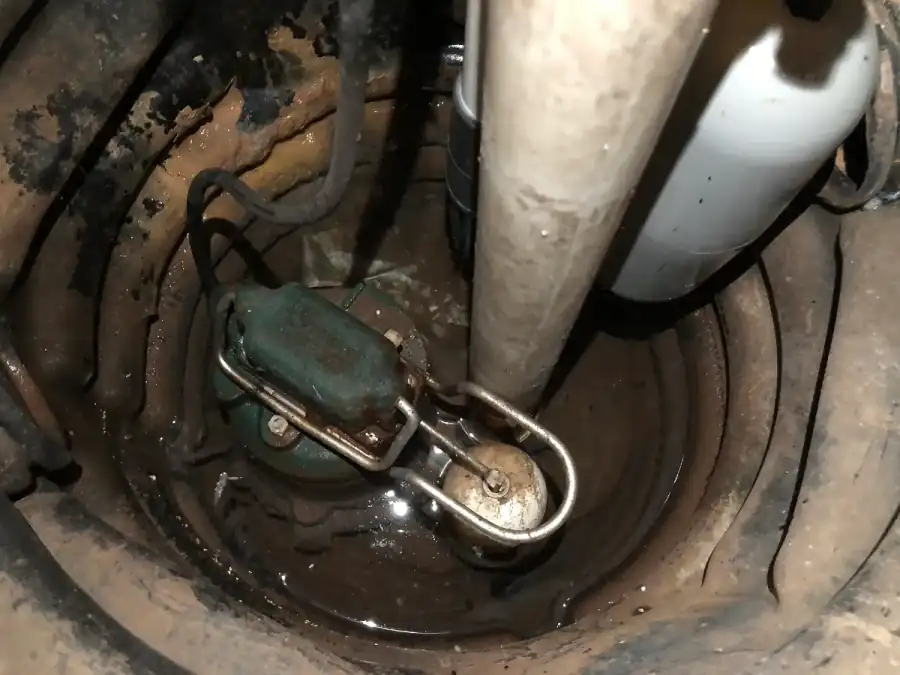

For most leaks at the joint between the wall and the floor, an interior drain is the usual fix. Exterior work makes more sense when the wall itself is being damaged, when the basement is being dug out anyway, or when a finished interior would have to be torn out for an interior drain.
How to Estimate Your Own Drain System Cost
Drain systems are priced by the linear foot, so the perimeter of your basement matters more than its floor area. You can check a quote with this formula:
Interior drain cost = perimeter (ft) × price per linear ft + sump pump
Example: Suppose your basement measures 25 × 40 feet, which is 1,000 sq ft. The perimeter is 2 × (25 + 40) = 130 feet. At Fixr's $40 to $120 per linear foot, a drain along every wall costs 130 × $40–$120 = $5,200 to $15,600. A sump pump adds $600 to $2,500, so the full interior system lands at about $5,800 to $18,100.
That range explains why quotes for the same basement differ so much. If water only enters along one 40-foot wall, a drain on that wall alone costs about $1,600 to $4,800 before the pump. Ask the contractor which walls actually leak and why every wall is on the quote.
What Makes Basement Waterproofing Cost More?
Two basements of the same size can differ in price by thousands of dollars. Below I am sharing the factors that push the price up.
- Foundation type: This Old House notes that block walls generally cost more to waterproof than poured concrete, because water travels through the hollow cores.
- Basement depth: A deeper wall means more digging for exterior work and more wall area to treat.
- Finished space: Drywall, flooring and built-ins have to come out before an interior drain goes in, and go back after.
- Soil and access: Clay or rocky soil, tight side yards, decks, patios and driveways slow excavation.
- Existing damage: Mold, rotten framing or a cracked and moving wall must be dealt with first. Fixr puts mold remediation at $500 to $1,500, and up to $6,000 in severe cases.
- Permits: Both guides put permit fees at about $75 to $500, depending on your local building department.
A wall that is bowing inward is a structural problem as well as a water problem. Waterproofing will not stop it moving, so read our guide to a bowing basement wall before you sign a waterproofing contract.
What the Building Code Requires
The International Residential Code, published by the International Code Council and adopted by most US states, sets two levels of protection for new basement walls in Section R406. Under R406.1, walls that hold back soil around a basement need damp proofing on the outside, from finished grade down to the footing. Under R406.2, walls in "areas where a high water table or other severe soil-water conditions are known to exist" need full waterproofing, using listed membranes such as 40-mil polymer-modified asphalt or 60-mil flexible polymer cement.
These rules apply to new construction, so an older house may have only damp proofing, or nothing at all. If your house sits on a high water table, a quote that only adds an interior sealant does not match what the code asks of a new house in the same spot.
Cheap Fixes to Try Before You Pay for a System
Most basement water starts as rain on the roof and the yard. Below I am sharing the low-cost steps that often stop a leak before any system is needed.
- Clean the gutters: Overflowing gutters dump water right against the foundation wall.
- Extend the downspouts: Carry roof water several feet away from the house instead of letting it soak in at the wall.
- Regrade the soil: Ground that slopes toward the house sends rain to the wall. Fixr puts professional regrading at $500 to $3,000.
- Seal one leaking crack: If water enters at a single crack, injection costs far less than a perimeter drain.
- Watch the next storms: Note where and when water appears. A leak that follows heavy rain points to surface water; water that rises through the floor points to groundwater.

How to Check a Basement Waterproofing Quote
A fair quote is specific about where and how water will be handled. Below I am sharing the line items your quote needs to show.
- Cause of the water: Where the water enters and why, in writing, before any method is named.
- Method and length: The method for each wall and the number of linear feet of drain, so you can apply the formula above.
- Sump pump details: The pump model, the pit size, where the discharge pipe ends and whether a battery backup is included.
- Prep and restoration: Who removes and replaces drywall, flooring, landscaping or concrete, and at what price.
- Permits: Who pulls the permit and whether the fee is included.
- Warranty: What it covers, how long it lasts and whether it transfers to a buyer.
Our repair quote checklist covers the questions to ask before you sign any basement or foundation contract.
Does Insurance Pay for Basement Waterproofing?
Insurance pays for sudden damage, not for prevention, so waterproofing itself is almost always your cost. Flood damage is a separate matter. Standard homeowners policies do not cover flooding, and FEMA's fact sheet on basements says National Flood Insurance Program coverage in a basement is limited. It covers listed building items such as sump pumps, furnaces, water heaters and unfinished drywall, but it excludes basement improvements such as finished walls, finished flooring and built-ins. Read your own policy before you finish a basement that has ever taken on water.
So, Is Basement Waterproofing Worth the Cost?
The answer depends on how often water gets in and what you plan to do with the space.
- If water appears only after big storms in one spot: Fix gutters, downspouts and grading first. A full system is rarely worth it at this stage.
- If water enters along the wall-floor joint after most heavy rains: An interior drain and sump pump is usually worth it, especially before you finish the basement.
- If you plan to finish the basement: Solve the water first. Finished walls and floors are what an NFIP policy excludes, so a wet finished basement is an expensive loss.
- If the wall is cracked and moving: Pay for a structural assessment first, because waterproofing does not fix a failing wall.
Common Mistakes to Avoid When Pricing Waterproofing
- Comparing totals instead of methods: A cheaper quote may seal the walls while a dearer one installs a drain. They are not the same job.
- Skipping the outside fixes: Paying for an interior system while downspouts still empty against the wall wastes money.
- Trusting paint for real leaks: Waterproof paint handles light damp. It does not hold back water under pressure.
- Pricing every wall by default: If one wall leaks, ask why the quote covers the whole perimeter.
- Ignoring the sump pump: An interior system stops working when the pump fails or the power goes out.
Conclusion
Basement waterproofing costs about $5,000 on average, with most jobs between $3,000 and $10,000, while full systems on larger basements pass $20,000. The method sets the price: outside fixes for surface water cost hundreds, interior drains cost thousands, and excavation costs the most. Find where the water enters, try the cheap outside fixes first, use the perimeter formula to check any drain quote, and compare itemized quotes method by method. When you want to read more, browse our independent price guides for basement and foundation work.
Frequently Asked Questions
-
How much does it cost to waterproof a 1,000 sq ft basement?
Fixr's February 2026 data puts a 1,000 sq ft basement at about $3,000 to $10,000, based on $3 to $10 per square foot. This Old House, using Homewyse and Angi data, puts the same size at about $12,447 to $14,833. The lower figure fits sealing and partial work; the higher one fits a full drain system or exterior excavation.
-
Is waterproofing a basement worth it?
It is worth it when water gets in after most heavy rains, when you plan to finish the basement, or when damp is damaging stored items, framing or flooring. It is not worth a full system when the only problem is occasional damp in one corner, because gutters, downspout extensions and grading often fix that for a few hundred dollars.
-
Will insurance pay for basement waterproofing?
Usually not, because waterproofing prevents future damage rather than repairing a sudden loss. Standard homeowners policies do not cover flooding. A National Flood Insurance Program policy covers listed basement items such as sump pumps and furnaces, but FEMA excludes basement improvements such as finished walls and floors. Read your own policy wording.
-
How long should basement waterproofing last?
It depends on the method. This Old House says waterproof paint needs reapplying every 5 to 10 years. Drain systems and exterior membranes last much longer when they are installed well, while sump pumps are mechanical and wear out. Ask what the warranty covers, how long it runs and whether it transfers to a buyer.
-
What is the cheapest way to waterproof a basement?
The cheapest fixes are outside. Cleaning gutters, extending downspouts away from the house and regrading soil so it slopes away from the wall cost far less than any interior system. Fixr puts gutters and downspouts at $3 to $30 per linear foot and regrading at $500 to $3,000. Waterproof paint inside costs $1 to $8 per square foot but only handles light damp.
-
Is interior or exterior basement waterproofing better?
Exterior waterproofing stops water before it reaches the wall, so it protects the wall itself, but excavation makes it the expensive option. Interior drainage does not stop water entering the wall; it collects the water at the floor edge and pumps it out. Interior systems cost less and suit most leaks through the wall-floor joint.
Sources and Standards
- Fixr, basement waterproofing cost, updated February 6, 2026.
- This Old House, basement waterproofing cost (Homewyse and Angi data), updated March 4, 2026.
- International Code Council, International Residential Code Section R406, Foundation waterproofing and dampproofing, as adopted in the 2025 California Residential Code.
- FEMA, What Does Flood Insurance Cover in a Basement? fact sheet, January 2022.
- BSI, BS 8102:2022, Protection of below ground structures against water ingress.
This guide is general information and does not replace an on-site inspection by a qualified professional. Read our disclaimer.