Checklist guideInspections & Buying
Is Your Foundation Repair Quote Fair? A Line-Item Checklist
Two quotes for the same crack can differ by thousands of dollars. This checklist shows what a fair quote should list, how to compare quotes line by line, and which warning signs mean you should stop.
A foundation repair quote is a contractor's written offer to do specific repair work for a stated price. A fair one tells you what is wrong, what will be done, where, in what quantity and at what cost. An unfair one gives you a large number and very little else. This checklist is part of our inspections and buying hub, which helps you get independent answers before you spend money.
If you are holding a quote that made your stomach drop, you are not alone. Homeowners often receive five-figure quotes after a short visit, with a salesperson pressing them to sign the same day. In this guide I will explain what a fair quote should list, what each item usually costs, how to compare quotes, which red flags to watch for, and how to read the contract and warranty before you sign.
Short answer
A foundation repair quote is fair when it names the cause, lists quantities and unit prices, states exclusions, and matches an engineer's scope. Piers should fall near $1,000 to $3,000 each. Get three quotes on the same scope and compare them line by line. Pay in stages, never in full upfront, and read the written warranty before you sign.
Likely fair
Itemized and explained
Cause, quantities, unit prices, exclusions and a staged payment schedule.
Ask questions
Gaps in the scope
Missing permits, drainage or warranty terms. Get answers in writing.
Stop
Pressure or lump sums
Sign-today discounts, full payment upfront or no written contract.
What Should a Foundation Repair Quote Include?
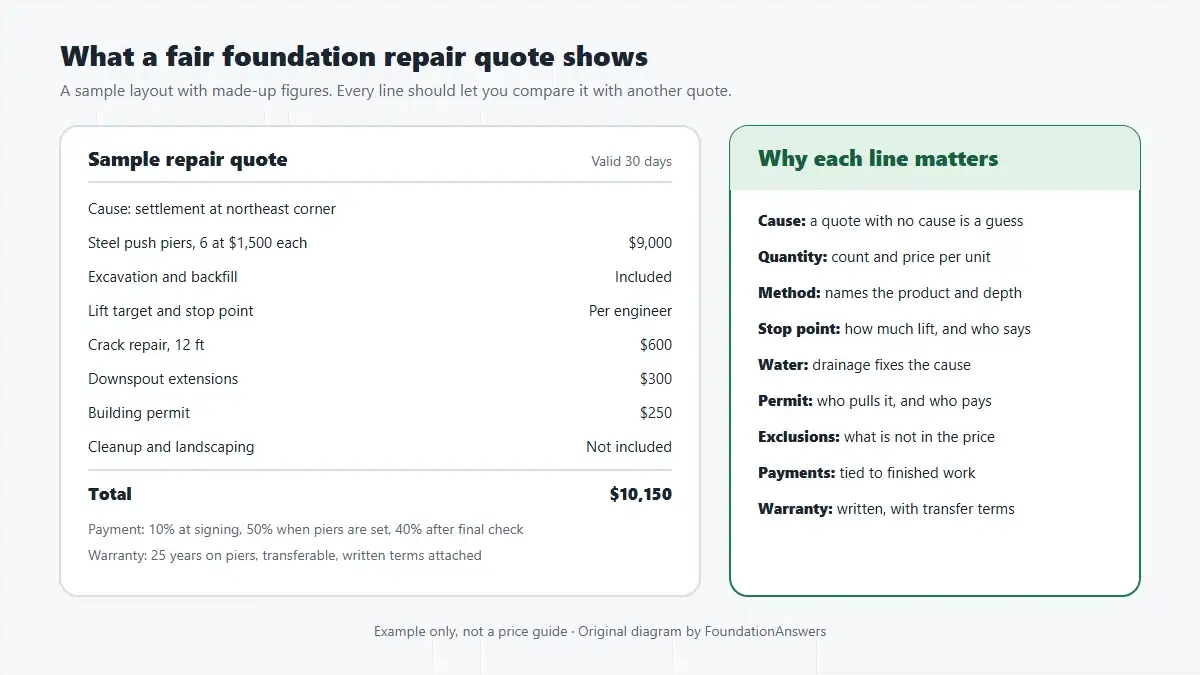
The FTC says a contract should cover the who, what, where, when and cost of a project. A foundation quote needs a few more details, because the work is hidden underground. Below I am sharing the line items to look for in a table.
| Line item | What it should say | Why it matters |
|---|---|---|
| Cause | What moved and why | A repair that ignores the cause may not last |
| Method | Product and system by name | Different methods carry different prices |
| Quantity | Number of piers, anchors or feet of crack | Lets you compare unit prices |
| Location | A sketch or plan of where the work goes | Shows exactly what you are paying for |
| Depth or load | Target depth or load for piers | Shows when a pier counts as finished |
| Lift or stop point | How much lift is planned, and who decides | Over-lifting can crack finishes |
| Drainage | Included, or why it is not needed | Water is a common cause of movement |
| Permits and engineering | Who gets them and who pays | The FTC says the contract should state this |
| Restoration | Landscaping, concrete, drywall and cleanup | Often excluded, and it can add up |
| Exclusions | A clear list of what is not covered | Stops surprises and extra charges |
| Schedule and payment | Start date, finish date and payment stages | Keeps you in control of the money |
| Warranty | Full written terms attached | The label means little without them |
As the table shows, a fair quote answers what, where, how much and who is responsible. If a line is missing, it does not always mean the contractor is dishonest. It does mean you should ask, and get the answer added in writing before you sign.
How Much Should Each Item Cost?
Prices vary with soil, access, depth and region. Below I am sharing typical 2026 US prices in a table, so you have a benchmark for each line.
| Item | Typical cost | Source |
|---|---|---|
| Foundation repair, overall average | $5,179 ($2,224–$8,134) | This Old House, Oct 2026 |
| Piering, per pier | $1,000–$3,000 | This Old House, Oct 2026 |
| Crack filling | $250–$800 | This Old House, Oct 2026 |
| Carbon fiber straps, bowing wall | $2,000–$5,000 | Modernize, Aug 2026 |
| Wall anchors, bowing wall | $3,000–$8,000 | Modernize, Aug 2026 |
| Helical tiebacks, bowing wall | $6,000–$12,000 | Modernize, Aug 2026 |
| Engineer's foundation inspection | About $600 ($300–$1,000) | This Old House, 2026 |
| City permit | $100–$400 | This Old House, Apr 2026 |
As the table shows, a pier job scales with the pier count, so a quote for many piers can sit far above the overall average and still be fair. The unit price is the better test. If your quote is well outside these ranges, ask why. Rock, tight access or deep soil can justify it, but the contractor should be able to explain it.
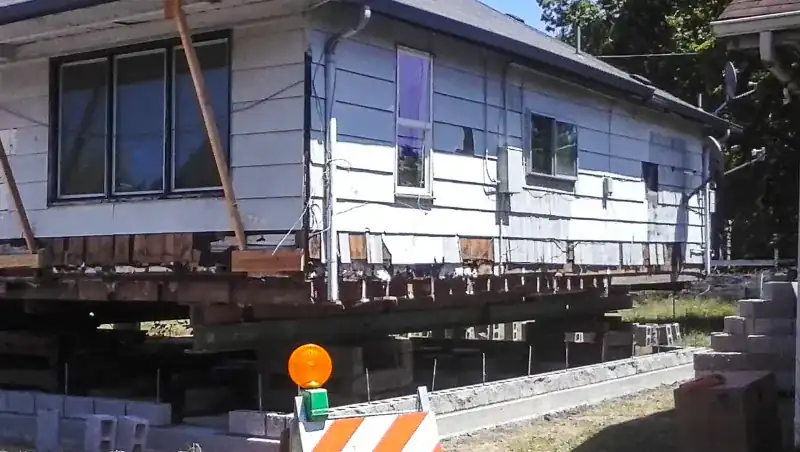

How to Compare Foundation Repair Quotes
Comparing totals is the most common mistake, because a low total can simply mean less work. Below I am sharing the steps that give you a fair comparison.
- Start with one scope: Ask a structural engineer to write the repair scope and give it to every contractor. Our guide to the structural engineer vs home inspector explains who does what.
- Make a table: List every line item down the side and each quote across the top.
- Mark the gaps: Note which quote leaves out drainage, permits, cleanup or restoration.
- Price the gaps: Add what you would pay elsewhere for each missing item.
- Work out the unit price: Divide the pier or anchor cost by the quantity.
- Ask about differences: If the pier counts differ, ask each contractor to explain the spacing.
Use this simple formula for each quote:
Comparable price = quoted total + cost of the items it leaves out
Example: Suppose you have three quotes. Quote A is $8,000 for 4 piers, with no crack repair, drainage or permit. Quote B is $10,150 for 6 piers with all of those included. Quote C is $17,000 for 8 piers, also all-inclusive. If those missing items cost $1,150, Quote A becomes $9,150, and it works out to $2,000 per pier. Quote B works out to $1,500 per pier. So the lowest total is not the lowest price. If the engineer's scope calls for 6 piers, Quote A would really cost about $13,150, which is $3,000 more than Quote B.
Foundation Repair Quote Red Flags
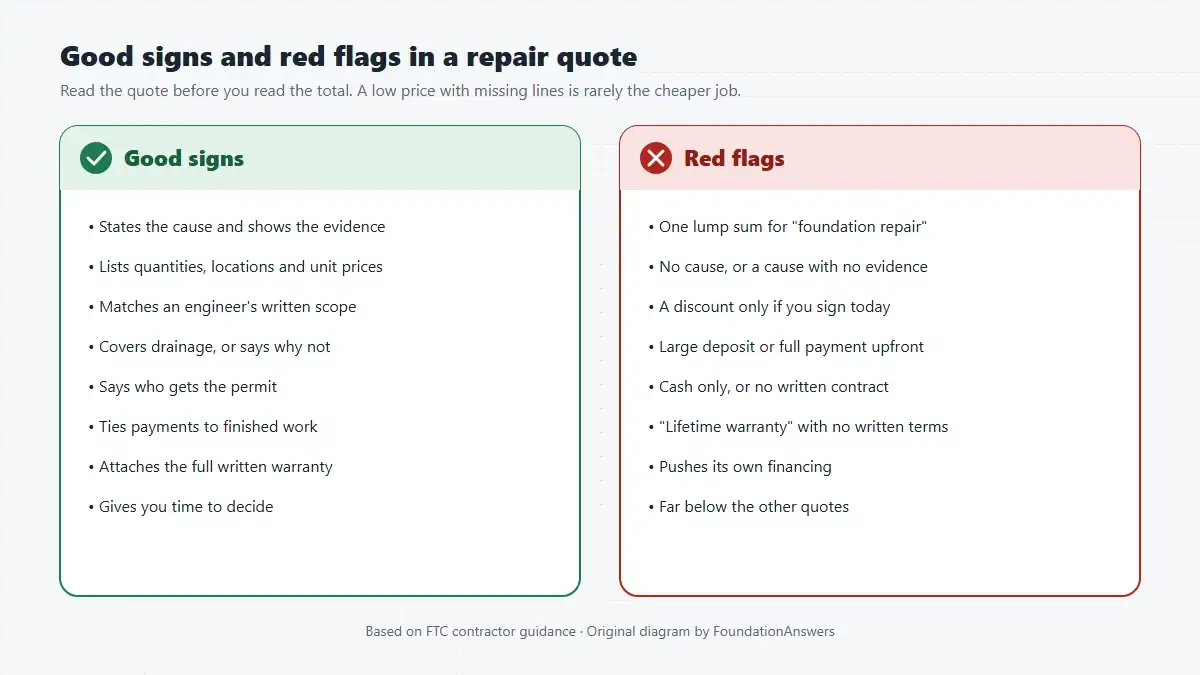
Some warning signs are about the numbers, and others are about behavior. Below I am sharing the ones that should make you slow down.
- A lump sum: One price for "foundation repair" cannot be checked or compared.
- No diagnosis: A quote that does not explain the cause is selling a product, not solving a problem.
- Pressure to sign today: A discount that ends tonight is a sales tactic. A fair price will still be fair next week.
- Large payment upfront: The FTC warns against paying the full amount upfront.
- Cash only, or no contract: Ask for a written agreement even if your state does not require one.
- Pushed financing: The FTC advises comparing loan terms before you agree to financing through a contractor.
- Blank spaces: Never sign a document with blanks or one you have not read.
- A price far below the others: It usually means less work, or extras that appear later.
What to Check in the Contract and Payment Schedule
The quote becomes binding once it turns into a contract, so check it line by line. The FTC's advice for hiring a contractor gives a good checklist. Below I am sharing what to confirm before you sign.
- Contractor details: Name, address, phone and license number where your state requires one.
- Dates: Estimated start and completion dates.
- Scope: The full scope of work, with every verbal promise written in.
- Payment schedule: Payments tied to defined stages of finished work.
- Permits: Who is responsible for getting them.
- Insurance: Proof of current insurance, which you should ask to see.
- Right to cancel: A written statement of your right to cancel within three business days if you signed at home or away from the seller's permanent place of business.
- Final payment: Held until the work is done, the permit is closed and you are satisfied. Confirm that subcontractors and suppliers have been paid, so nobody can place a lien on your home.
Keep the contract, change orders, letters and a record of all payments together. You will need them for a warranty claim, and a buyer will ask for them when you sell. If you are buying the house, our guide to buying a house with foundation problems shows how to use quotes in your negotiation.
How to Read a Foundation Repair Warranty
"Lifetime warranty" is a sales phrase until you read the terms, and the terms differ from company to company. Below I am sharing the questions to answer from the written warranty.
- What is covered: The piers alone, or also the walls, slab and finishes around them?
- What the remedy is: Will the contractor readjust the piers, refund you or something else?
- Where it applies: Only the repaired section, or the whole foundation?
- What voids it: Drainage changes, plumbing leaks, later alterations or missed maintenance?
- Whether it transfers: Is there a fee, a form or a deadline when you sell?
- Who stands behind it: The contractor, the manufacturer or an insurer, and what happens if the company closes?

When Should You Get a Second Opinion?
A second opinion costs little compared with most repairs. Below I am sharing the situations where it is worth paying for one.
- The quote is large: A five-figure job justifies about $600 for an independent assessment.
- The quotes disagree: Different causes or methods mean somebody may be wrong.
- The contractor cannot explain the cause: You need a diagnosis before a repair.
- Only the repair company has looked: It earns money from what it recommends.
- The problem may be water: A drainage fix may cost far less than structural work. Our guide to basement waterproofing cost shows the typical prices.
So, Is Your Repair Quote Fair?
The answer depends on what you are holding.
- If you have one quote and it is itemized: Get two more on the same scope before you decide.
- If you have a lump sum: Ask for quantities and unit prices. If the contractor refuses, move on.
- If your quotes differ widely: Compare the scopes, then ask an engineer which one fits the house.
- If you are buying the house: Use the engineer's scope and three quotes as evidence in the negotiation.
- If you already signed at home: Check your right to cancel right away, because the window is short.
- If the unit prices fit and the contract is clear: The quote is probably fair. Check references and insurance, then decide.
What You Should Do: Do not judge the total first. Check the cause, then the scope, then the unit prices, then the contract and warranty. If all four hold up, the total is probably reasonable.
Common Mistakes to Avoid With Repair Quotes
- Choosing the lowest total: It may leave out work you will pay for later.
- Letting each contractor set the scope: You end up comparing different jobs.
- Trusting verbal promises: If it is not in the contract, you cannot rely on it.
- Paying ahead of the work: Once you have paid, you have lost your best way to get problems fixed.
- Ignoring restoration: Replacing landscaping, concrete and drywall can add a real cost.
- Skipping the permit question: Unpermitted structural work can cause trouble when you sell.
- Fixing the structure and not the water: The same cause can damage the same foundation again.
Conclusion
A fair foundation repair quote names the cause, lists quantities and unit prices, states exclusions, and comes with clear payment stages and a written warranty. Check each unit price against the published ranges, get three quotes on one scope, and add the cost of missing items before you compare totals. Walk away from pressure, lump sums and large upfront payments. For more help, browse our engineer-checked help before you pay for repairs.
Frequently Asked Questions
-
How do I know if a foundation repair quote is fair?
A fair quote names the cause, lists quantities, locations and unit prices, and states what is excluded. Check the unit prices against published ranges, such as $1,000 to $3,000 per pier from This Old House. Then compare it with at least two other quotes built on the same scope, ideally an engineer's written scope.
-
How many foundation repair quotes should I get?
Three is a sensible number, because it shows you the normal price and makes an unusually high or low quote easy to spot. The quotes only help if they price the same work. Give every contractor the same engineer's scope, or ask each one to explain any difference in method and quantity.
-
How much deposit should I pay for foundation repair?
Keep it as small as you can, and never pay the full amount upfront. The FTC notes that some states limit how much a contractor can ask for as a down payment. It also advises tying payments to completed stages of work and holding the final payment until the job is done and you are satisfied.
-
Why are foundation repair quotes so different?
Quotes usually differ because they price different work. One may include six piers, drainage and a permit, while another has four piers and leaves the rest out. Method, pier depth, access, and warranty terms also change the price. Compare the scope line by line before you compare totals.
-
Can I cancel a foundation repair contract after signing?
Often, if you signed at home. The FTC's Cooling-Off Rule gives you three business days to cancel covered sales made at your home or away from the seller's permanent place of business, and contractors must give you written notice of that right. Check your state's rules too, and send any cancellation in writing.
-
Is a lifetime warranty on foundation repair worth it?
It is only worth what the written terms say. Read which parts are covered, whether it covers the piers alone or the whole foundation, what voids it, whether it transfers to a new owner, and what happens if the company closes. A vague promise with no written terms is worth little.
Sources and Standards
- Federal Trade Commission, How to avoid a home improvement scam.
- Federal Trade Commission, Hiring a contractor.
- Federal Trade Commission, Cooling-off period for sales made at home or other locations.
- This Old House, Foundation repair cost, updated October 2026.
- This Old House, How much does a foundation inspection cost?, 2026.
- This Old House, Foundation inspection: why hire a structural engineer, updated April 2026.
- Modernize, Bowing basement wall repair cost, updated August 2026.
This guide is general information and does not replace an on-site inspection by a qualified professional. Read our disclaimer.