Decision guideInspections & Buying
Should You Buy a House With Foundation Problems?
A foundation note in the inspection report is not an automatic no. What the engineer finds, what your lender will accept and what the repair costs decide whether you buy, negotiate or walk away.
Buying a house with foundation problems means buying a home whose footings, slab, walls or piers have cracked, settled, bowed or moved enough that a home inspector flagged them. Some of these problems are cosmetic, some are repairable for a few thousand dollars, and a few are too large or too uncertain to take on. This guide is part of our inspections and buying hub, which covers inspections, quotes and selling as well.
If your inspector just wrote "recommend evaluation by a structural engineer" and your contingency clock is ticking, you are not alone in feeling stuck. Most buyers have never read a foundation report, and the seller's agent may tell you the cracks are normal. In this guide I will explain which foundation problems are deal breakers and how lenders and insurers react to them. I will also show you how to check the house before your deadline, what repairs cost, and how to turn a repair estimate into a better deal.
Short answer
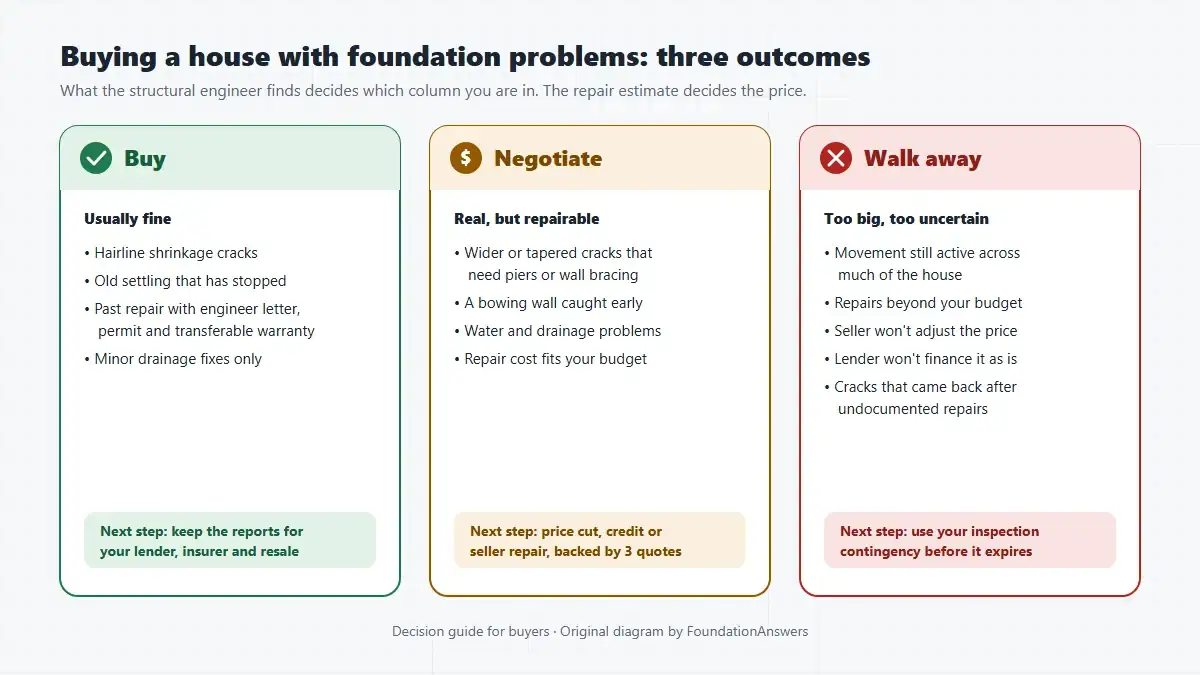
You can buy a house with foundation problems if a structural engineer confirms the problem is repairable. Get repair quotes before your inspection contingency ends, and make sure the price drops enough to cover the repair and your lender will still finance the house. Walk away when movement is active across much of the house, the repair is beyond your budget, or the seller will not adjust.
Buy
Minor or documented
Hairline cracks, old settling that stopped, or a past repair with paperwork.
Negotiate
Real but repairable
Wider cracks, an early bowing wall or drainage faults with a quoted repair.
Walk away
Active or uncertain
Movement still going on, no clear repair scope, or no loan until it is fixed.
What Counts as a Foundation Problem When You Buy a House?
Inspection reports use the word "foundation" for everything from a hairline crack to a failing wall. NAHB points out that most cracks are cosmetic and lists the signs that point to a structural problem. Below I am sharing the findings buyers see most often in a table.
| Inspection finding | Usually means | Buyer's next step |
|---|---|---|
| Hairline vertical crack in a poured wall or slab | Concrete shrinkage | Note it; seal if it leaks |
| Thin cracks at drywall corners, stable for years | Normal settling and drying lumber | Usually no action |
| Diagonal crack wider at one end | Uneven settlement | Engineer evaluation |
| Stair-step crack in block or brick | Uneven settlement or soil pressure | Engineer evaluation |
| Horizontal crack or inward bow in a basement wall | Soil pressure pushing the wall | Engineer evaluation; often a repair |
| Sloping floors, sticking doors, gaps at trim | Movement of the foundation or framing | Engineer evaluation |
| Water stains, efflorescence, a wet crawl space | Drainage or groundwater problem | Find the source; quote the fix |
| Piers, wall anchors or patched cracks already in place | A past repair | Ask for the paperwork |
As the table shows, the shape and location of the damage matter more than the word in the report. A thin vertical crack is the most common finding and is rarely a reason to back out. Tapered, stepped, horizontal or bowing damage needs an engineer's opinion before you decide anything. Our guide to house settling cracks explains how to read a crack's shape and width.
Why Foundation Problems Matter More When You Buy
An owner who finds a crack can watch it for a year. A buyer has a few days and has to commit money before the problem is fully understood. Below I am sharing the reasons a foundation problem weighs more heavily on a purchase.
- Your lender may not lend on it as is: FHA, VA and conventional loan rules all require repairs when a defect affects structural soundness. The problem can delay or block closing.
- Your insurer probably will not pay for it: Triple-I notes that most US property policies exclude earth movement, and standard homeowners policies also exclude settling and the cracking it causes.
- You pay for the repair after closing: Once you own the house, the repair is yours, and a known defect is hard to recover from the seller later.
- It affects resale: In most states you will have to disclose the problem and the repair when you sell, so paperwork showing a proper, engineered repair protects your future price.
- Repairs can grow: A contractor may find more damage once walls are opened or soil is dug out, so an early quote is a starting point, not a final number.
How Do Lenders Treat Foundation Problems?
The appraiser works for the lender, not for you, and federal and agency rules tell the appraiser what to do about structural defects. Below I am sharing how the main US loan types handle foundation problems.
| Loan type | Rule | What it means for you |
|---|---|---|
| FHA | HUD Handbook 4000.1 requires an insured home to be safe, sound and secure. The lender applies repair requirements when the appraisal or an inspection shows repairs are needed | A structural defect is normally repaired before the loan closes |
| VA | VA minimum property requirements treat conditions that impair structural soundness, including continuing settlement, as unacceptable until fixed and further damage is stopped | Active settlement must be repaired first; minor hairline settlement cracks usually need no repair |
| Conventional (Fannie Mae) | Selling Guide B4-1.3-06 requires an appraisal subject to repairs when a condition affects safety, soundness or structural integrity, and names foundation cracks or settlement as examples | The lender wants a certificate of completion before or as a condition of the loan |
| FHA Standard 203(k) | Finances the purchase and structural repairs together, including repairing or reconstructing a foundation; minimum repair cost $5,000; a 203(k) consultant is required | A way to buy a house that needs foundation work with one loan |
| FHA Limited 203(k) | Up to $75,000 in repairs, but nonstructural only | Cannot be used for foundation repairs |
As the table shows, every major loan type expects a structural defect to be fixed or financed through a renovation loan. The practical problem is timing. The seller still owns the house before closing, so either the seller repairs it or you use a 203(k) loan that pays for the work after you buy. Tell your loan officer about the foundation finding as soon as you see it, not after the appraisal comes back.
How to Check the House Before You Buy
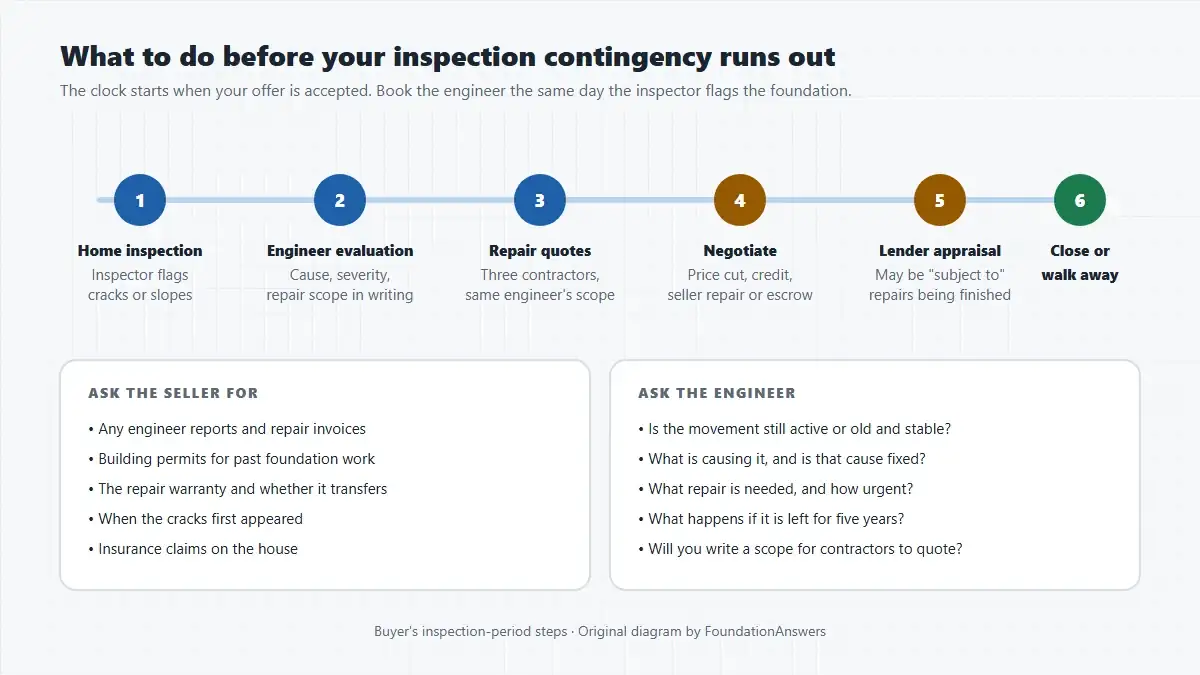
A home inspector looks for symptoms; a structural engineer diagnoses the cause. Below I am sharing the steps to finish before your inspection contingency expires.
- Book a structural engineer the same day: Engineers are often booked days ahead. Ask for a written report on the cause, whether movement is active, the repair needed and its urgency.
- Ask for an extension if you need one: If the engineer cannot come before the deadline, ask the seller in writing to extend the inspection period.
- Request the seller's records: Earlier engineer reports, repair invoices, permits, warranties, and any insurance claims on the house.
- Get three quotes on the engineer's scope: Quotes built on the same scope can be compared. Quotes where each contractor decides the scope cannot.
- Check the warranty transfer: Repair warranties differ on whether, and how, they pass to a new owner. Read the terms and any transfer steps before you rely on one.
- Talk to your lender and insurer: Ask how the finding affects your loan and whether the insurer will write the policy.
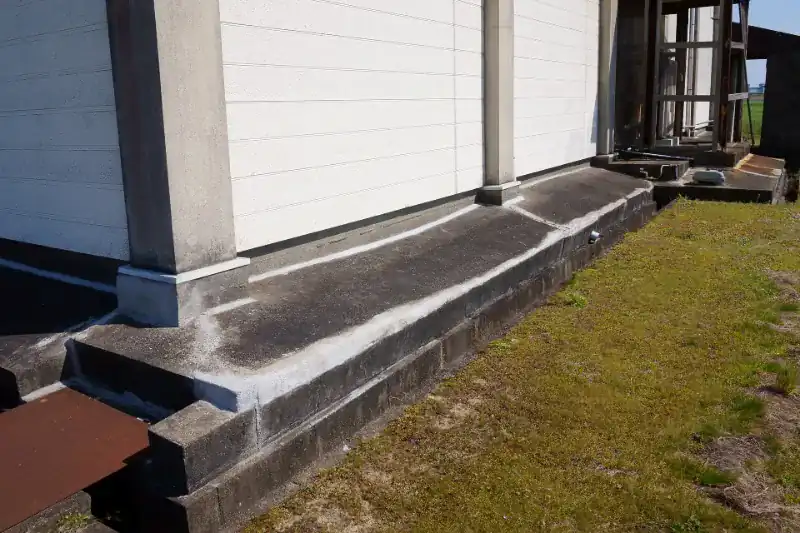

Patched cracks deserve extra questions. Patching is normal maintenance, but a crack that was filled and has opened again shows that the movement behind it has not stopped.
How Much Do Foundation Repairs Cost?
Repair cost depends on the cause and the method. Below I am sharing typical 2026 US prices in a table.
| Item | Typical cost | Source |
|---|---|---|
| Structural engineer's assessment | $500–$1,000 | This Old House, Oct 2026 |
| Foundation crack filling | $250–$800 | This Old House, Oct 2026 |
| Foundation repair, average | $5,179 ($2,224–$8,134) | This Old House, Oct 2026 |
| Piering, per pier | $1,000–$3,000 | This Old House, Oct 2026 |
As the table shows, the engineer's fee is small next to the repair, and pier jobs scale with the number of piers. A bowing basement wall has its own range of repairs, from wall anchors to bracing to rebuilding, which our bowing basement wall guide explains.
To turn quotes into an offer, I suggest a simple formula:
Repair allowance = middle repair quote + engineer's fee + a margin for surprises
Example: Suppose the engineer finds that one corner of the house has settled and calls for 6 piers. At $1,000 to $3,000 per pier, that is $6,000 to $18,000, and your three quotes come in at $9,000, $11,000 and $14,000. Take the middle quote of $11,000, add the $750 engineer's fee, and add a margin of, say, $2,000 for drywall and door repairs after the lift. Your repair allowance is about $13,750, and that is the number you take to the seller with the quotes attached.
Price Cut, Repair Credit, Seller Repair or Escrow?
Once you know the repair cost, you have four main ways to ask the seller to share it. Below I am sharing them in a table.
| Option | How it works | Watch out for |
|---|---|---|
| Price reduction | The sale price drops by the repair allowance | The lender may still require the repair before closing |
| Repair credit | The seller pays part of your closing costs | Lenders limit seller credits, and a credit covers closing costs, not the repair itself |
| Seller repairs before closing | The seller hires a contractor and finishes the work | The seller may choose the cheapest fix; insist on the engineer's scope, permits and a transferable warranty |
| Repair escrow | Money is held at closing and released when the work is done | Needs lender approval and a clear written scope |
As the table shows, a price reduction gives you the most control, but only if your lender will close without the repair. A seller repair works best when your own engineer writes the scope and checks the finished work. Ask your lender which options it accepts before you write the repair request.

Benefits and Possible Drawbacks of Buying a House With Foundation Problems
Below I am sharing the benefits first.
- A lower price: Many buyers walk away, so a house with a known, repairable problem can be bought for less.
- Less competition: Fewer offers give you more room to negotiate terms and timing.
- A known problem, properly fixed: After an engineered repair with paperwork, you know more about this foundation than about most houses on the street.
Below I am sharing the possible drawbacks.
- Cost overruns: Hidden damage can push the repair past the quote.
- Financing friction: Repairs may have to be done before closing, which delays it or needs a renovation loan.
- No insurance backstop: Settling and earth movement are usually excluded, so the cost stays with you.
- Resale disclosure: You will likely have to disclose the history when you sell.
So, Should You Buy a House With Foundation Problems?
The answer depends on your situation.
- If you are a first-time buyer on an FHA or VA loan: Buy only if the seller finishes an engineered repair before closing, or you qualify for a Standard 203(k). Your loan cannot close on a house with active structural movement.
- If you are paying cash or buying as an investor: You have the most freedom. Buy when the engineer's scope is clear and the price cut covers your repair allowance.
- If the house had a past repair: Buy when the engineer's report, invoice, permit and transferable warranty are all there and your own engineer confirms the repair is holding.
- If movement is still active and the cause is unclear: Walk away. You cannot price a repair nobody can define.
- If the repair would empty your savings: Walk away, even if the repair is possible. A foundation repair with no cushion left for surprises is a financial risk.
What You Should Do: Book an engineer, get three quotes on the engineer's scope and bring a written repair request to the seller before your contingency ends. Our repair quote checklist helps you compare the quotes line by line.
Common Mistakes to Avoid When Buying a House With Foundation Problems
- Letting the contingency expire: Once it ends, you usually lose the right to back out over the inspection.
- Relying on the seller's contractor: A quote from a company that sells repairs is not an independent assessment.
- Accepting "it's just settling" from an agent: Only an engineer can tell you whether movement has stopped.
- Asking for a percentage off: Sellers push back on round numbers; they rarely argue with three written quotes.
- Ignoring water: Most foundation movement starts with poor drainage, and a repair that ignores the water will not last.
- Assuming the warranty transfers: Read the terms and complete any transfer steps before or right after closing.
Conclusion
Buying a house with foundation problems is often possible and sometimes a good deal, but only on facts. A structural engineer tells you whether the movement has stopped and what the repair is. Three quotes tell you what it costs, and your lender tells you whether it must be done before closing. Use those facts to ask for a price cut, a seller repair or an escrow. Walk away when the movement is active, the scope is unclear or the numbers do not work. For more help, browse our engineer-checked guides for home buyers and owners.
Frequently Asked Questions
-
Should I buy a house that had foundation repairs?
It can be a good buy if the repair is documented. Ask for the engineer's report that called for the repair, the contractor's invoice, any building permit and the warranty. Check whether the warranty transfers to you. Then have your own engineer confirm the repair is holding. A past repair with no paperwork, or cracks that have come back, is a reason to slow down or walk away.
-
Is it worth buying a house with foundation problems?
It is worth it when an engineer confirms the problem is repairable and quotes show what the repair costs. The price must drop enough to cover that cost, and your lender must still finance the house. It is not worth it when movement is active across much of the house, the repair scope is uncertain, or the seller will not adjust the price.
-
Can you get a mortgage on a house with foundation problems?
Often, but not always as is. VA rules treat conditions that impair structural soundness, such as continuing settlement, as unacceptable until they are fixed. Fannie Mae requires an appraisal subject to repairs when a condition affects structural integrity, and FHA requires homes to be safe, sound and secure. The usual path is to finish the repair before closing or to use a renovation loan such as the FHA Standard 203(k).
-
Will homeowners insurance cover foundation problems I knew about when I bought?
Usually not. Triple-I notes that most US property policies exclude earth movement, and standard policies also exclude settling, shrinking and resulting cracks. A problem you knew about before you bought is also hard to claim as sudden damage. Budget for the repair yourself rather than expecting an insurer to pay for it.
-
Do sellers have to disclose foundation problems?
In most US states, yes. Nolo reports that nearly every state requires sellers to disclose certain known material defects, usually on a standard form. Active concealment of a major defect is illegal in every state. A few states still lean on caveat emptor, so your own inspection and engineer's report remain your best protection.
-
How much should I ask off for foundation problems?
Base the number on the repair, not on a percentage. Get an engineer's written repair scope and collect three contractor quotes on that same scope. Then ask for at least the middle quote plus the engineer's fee and a margin for surprises. Bring the quotes to the negotiation so the seller sees where the number comes from.
Sources and Standards
- U.S. Department of Housing and Urban Development, Handbook 4000.1, FHA Single Family Housing Policy Handbook, current edition.
- U.S. Department of Housing and Urban Development, 203(k) Rehabilitation Mortgage Insurance Program, accessed October 2026.
- U.S. Department of Veterans Affairs, VA Lenders Handbook, Pamphlet 26-7, Chapter 12: Minimum Property Requirements.
- Fannie Mae, Selling Guide B4-1.3-06, Property Condition and Quality of Construction of the Improvements.
- Insurance Information Institute, Sinkholes and insurance (earth movement exclusion)
- Nolo, Selling a house with defects: what you must disclose.
- This Old House, Foundation repair cost, updated October 2026.
- National Association of Home Builders, W. Keaveny, PE, Misconceptions about the common crack, January 2018.
This guide is general information and does not replace an on-site inspection by a qualified professional. Read our disclaimer.