Diagnosis guideCrawl Spaces
Moisture in a Crawl Space: Where It Comes From, What Is Normal and How to Fix It
Three questions tell you whether you have leaking water, condensation or ground vapor. Two cheap readings tell you how bad it is. Then fix it from the cheapest step up.
Moisture in a crawl space is any water, liquid or vapor, that collects in the space under a raised floor. It shows up as standing water, wet soil, damp wood, dripping ducts or simply humid, musty air. Every crawl space has some moisture, because soil and outdoor air both carry water. The trouble starts when it stays high long enough to grow mold and rot the floor framing. This guide is part of our crawl space guides, which explain each problem from its cause to its fix.
If you opened the crawl space hatch and found damp soil, sweating pipes or a musty smell, you are not alone, and you do not need to panic or buy the biggest system on offer. In this guide I will explain where crawl space moisture comes from, how to tell which source you have, what humidity and wood moisture readings are normal, and how to fix the problem in order of cost.
Short answer
Crawl space moisture comes from four places: rain and groundwater, plumbing leaks, humid outdoor air condensing on cool surfaces, and vapor rising from bare soil. Fix liquid water first, then cover the soil with a sealed vapor barrier, then deal with humid air. Aim for relative humidity below 60% and wood moisture below 20%. Measure for two weeks before you pay for a full encapsulation.
Normal
Dry wood, RH under 60%
Soil is covered, wood reads under 20%, no standing water after rain. Keep checking once a year.
Needs a fix
Humid or sweating
Humidity stays above 60%, ducts drip in summer or the soil is bare. Cover the soil and stop the air leaks.
Act now
Standing water or wet wood
Water pools after rain, a pipe leaks or joists read above 20%. Fix the water source this month.
What Causes Moisture in a Crawl Space?
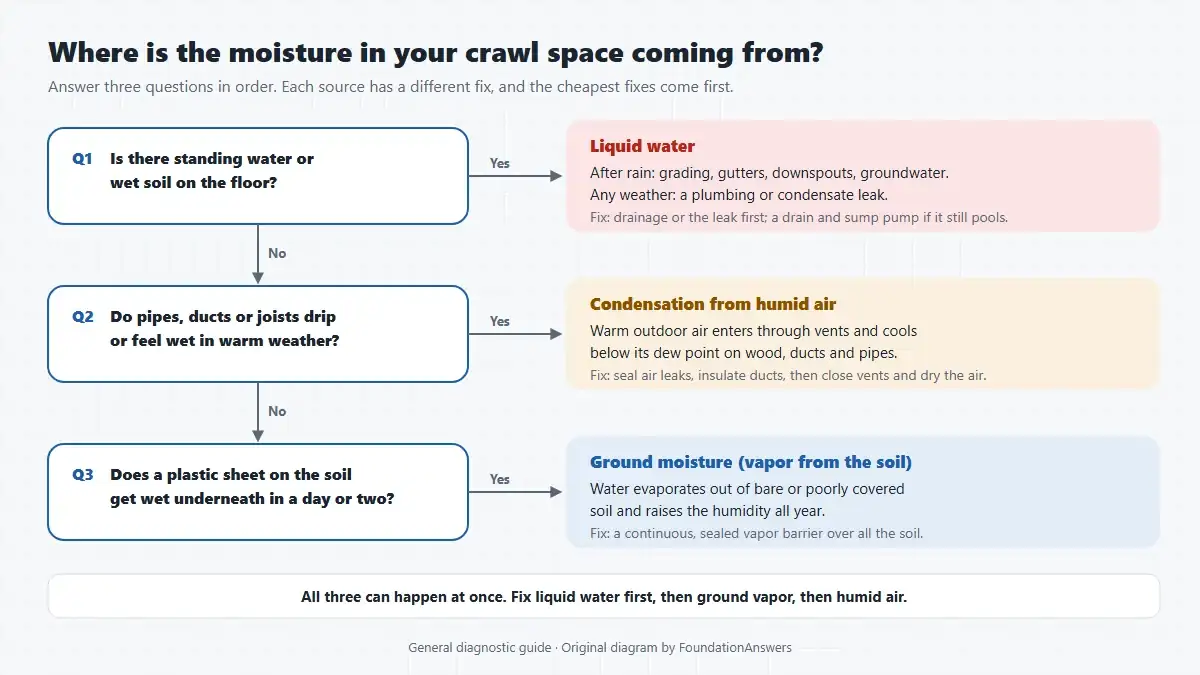
Every wet crawl space gets its water from one or more of four sources. Below I am sharing each one with the sign that gives it away.
- Rain and groundwater: Water reaches the crawl space when the ground slopes toward the house, gutters overflow or downspouts drop water at the wall. The sign is standing water or wet soil after rain, often near one wall.
- Plumbing and HVAC leaks: Supply lines, drain lines and air conditioner condensate lines drip in any weather. The sign is a wet patch under a pipe that never dries.
- Humid outdoor air: Warm summer air flows in through foundation vents and gaps, then cools below its dew point on the wood, pipes and ducts. The sign is droplets on cool surfaces in warm, humid weather.
- Vapor from the soil: Bare soil gives off water vapor all year, and a torn or loose liner lets it through. The sign is high humidity even when no water is visible.
The building code addresses two of these directly. The International Residential Code (IRC) requires the ground around a house to fall at least 6 inches within the first 10 feet away from the foundation (Section R401.3), and it sets rules for venting or sealing the crawl space (Section R408).
How to Find the Source of Crawl Space Moisture
You can identify the source yourself in a week or two. Below I am sharing the steps.
- Look after heavy rain: Check the crawl space within a day of a big storm. Water that appears only after rain points to drainage.
- Check the water meter: Turn off every tap and appliance and watch the meter for an hour. If it moves, you have a supply leak.
- Feel the ducts and pipes in summer: Droplets on cold lines on a warm, humid day mean condensation from humid air.
- Do the plastic sheet test: Tape a 2-foot square of clear plastic tightly onto bare soil and leave it for a day or two. Moisture under the sheet means vapor is rising from the soil.
- Log humidity for two weeks: Leave a digital hygrometer in the crawl space and note the readings morning and evening.
- Read the wood moisture: Use a pin moisture meter on two or three joists and the sill plate, away from the vents and near them.

What Moisture Readings Are Normal in a Crawl Space?
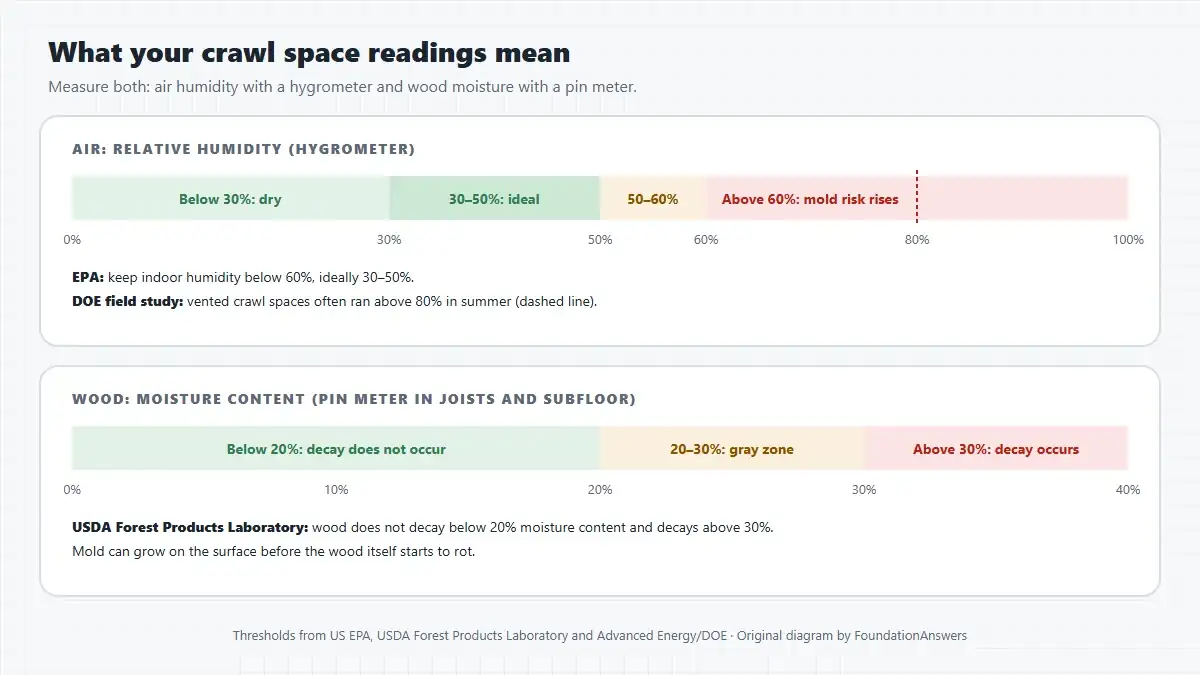
Two readings tell you how serious the problem is. Below I am explaining what each range means and what you need to do, in a table.
| Reading | What it means | What you need to do |
|---|---|---|
| Humidity 30–50%, wood under 20% | Dry and healthy | Recheck each summer |
| Humidity 50–60%, wood under 20% | Acceptable, close to the limit | Cover any bare soil and seal obvious air leaks |
| Humidity above 60% for weeks | Mold growth becomes likely | Vapor barrier, air sealing, then drying |
| Wood 20–30% | Damp; a gray zone for decay | Find and stop the water source now |
| Wood above 30% | Wood decay occurs | Fix the water, then have the framing checked |
As the table shows, the wood moisture reading matters more than the air reading. Humid air for a few days does little harm; framing that stays above 20% moisture is where mold and rot begin. The humidity targets come from the EPA, and the wood thresholds from USDA Forest Products Laboratory research.
Condensation follows a simple rule: water forms on any surface colder than the air's dew point. For example, outdoor air at 85°F and 70% relative humidity has a dew point of about 74°F. When that air enters a vented crawl space and touches a supply duct or joist at 70°F, water forms on it. That is why vented crawl spaces sweat in summer, and why a field study by Advanced Energy for the US Department of Energy recorded vented crawl spaces often above 80% humidity in summer.
How to Fix Moisture in a Crawl Space
Work from the cheapest fix up, and stop when your readings are normal. Below I am sharing the fixes in order, with typical 2026 costs from This Old House and HomeGuide cost data.
| Fix | Solves | Typical cost |
|---|---|---|
| Extend downspouts and clean gutters | Roof water dumped at the wall | Low; often DIY |
| Regrade soil away from the house | Surface water flowing toward the foundation | Varies with the yard |
| Repair plumbing and condensate leaks | Leaks in any weather | Depends on the leak |
| Seal air leaks and insulate ducts | Condensation on cold ducts and pipes | Low to moderate |
| Sealed vapor barrier over all soil | Vapor from the ground | About $2–$4 per sq ft installed |
| Interior drain and sump pump | Groundwater that still pools | About $600–$1,800 or more |
| Dehumidifier in a sealed space | Humid air that remains after the steps above | About $800–$3,000 installed |
| Full encapsulation | All sources in humid climates | Commonly $5,000–$15,000 |
As the table shows, the cheapest fixes deal with liquid water, and they come first for a reason: a liner and a dehumidifier cannot keep up with water that keeps flowing in. Our encapsulation cost breakdown lists every line item if you reach the last rows.
Example: Suppose your 1,200 sq ft crawl space has no standing water, the ducts sweat in July, the soil is bare and the joists read 19–22%. You need a sealed vapor barrier (about 1,200 × $2–$4 = $2,400–$4,800 installed), duct insulation and air sealing. If humidity stays above 60% after that, add a dehumidifier. You do not need a drain or sump pump, because no water pools.
So, Do You Need to Seal the Whole Crawl Space?
Sealing, or encapsulating, a crawl space is the most complete fix, but not every house needs it. The answer depends on your readings and your climate.
- Seal it if humidity stays above 60% after the soil is covered and the leaks are fixed, especially in a hot, humid climate.
- Seal it if ducts or the air handler sit in the crawl space and sweat every summer.
- Do not start with sealing if water pools after rain; fix drainage first.
- Do not seal if a vapor barrier and drainage already keep the wood under 20% and humidity under 60%.
Read our guide on whether crawl space encapsulation is worth it for the full decision, including combustion air, radon and termite checks.

What Happens If You Ignore Crawl Space Moisture?
Moisture under the floor does slow damage that gets more expensive each year. Below I am sharing what to expect.
- Mold on the framing: Wood that stays damp grows mold, and musty air rises into the rooms above. Our guide to crawl space mold explains how to size and clean it.
- Wood rot: Joists, sill plates and subfloors that stay above 30% moisture decay and lose strength.
- Sagging and cupped floors: Damp subfloors swell, and wood floors above them cup or buckle.
- Pests: Termites and other insects are drawn to damp wood and wet soil.
- Wasted insulation: Wet fiberglass between joists sags, falls and stops insulating.
Common Mistakes to Avoid With Crawl Space Moisture
- Buying a dehumidifier first: It cannot dry a space that keeps getting new water from leaks, drainage or bare soil.
- Laying plastic over standing water: A liner hides water instead of removing it. Fix the drainage first.
- Leaving gaps in the vapor barrier: Untaped seams and loose edges let soil vapor through. Overlap and seal every seam.
- Opening vents wider in summer: More humid air usually means more condensation, not less.
- Judging by smell or feel: A $20 hygrometer and a pin meter give you numbers you can act on and compare later.
- Forgetting combustion air: Closing vents around a gas furnace or water heater needs a professional plan for its air supply.
Conclusion
Moisture in a crawl space is normal in small amounts and harmful when it stays high. Find the source first: liquid water after rain or from a leak, condensation from humid air, or vapor from bare soil. Measure humidity and wood moisture, then fix the cheapest causes first and stop when wood moisture stays below 20% and the air below 60%. Check your local building department's rules before you change vents or drainage. For more help, browse our plain answers on damp, drainage and crawl space problems.
Frequently Asked Questions
-
Is it normal for a crawl space to have some moisture?
Yes, some moisture is normal, because soil always gives off water vapor and outdoor air carries humidity. What is not normal is standing water, wet wood, dripping ducts or humidity that stays above 60% for weeks. Those conditions feed mold and rot. Check with a hygrometer and a wood moisture meter rather than by feel.
-
What moisture reading is normal in a crawl space?
Aim for relative humidity below 60%, ideally 30–50%, which is the range the EPA recommends indoors. For wood, readings below 20% moisture content are safe; USDA Forest Products Laboratory research found that wood does not decay below 20% and does decay above 30%. Readings between 20% and 30% need attention.
-
How much does it cost to fix moisture in a crawl space?
It depends on the source. Extending downspouts or fixing a leak can cost very little. A professionally installed liner runs about $2–$4 per square foot, a crawl space dehumidifier about $800–$3,000 installed, and drainage with a sump pump about $600–$1,800 or more. Full encapsulation commonly runs $5,000–$15,000.
-
Will insurance cover water in a crawl space?
A homeowners policy usually covers sudden water damage, such as a burst pipe, but not gradual seepage, humidity or poor drainage. Groundwater and flooding need a flood policy, and FEMA's National Flood Insurance Program limits coverage in basements and crawl spaces to a short list of items. Read your policy before you file.
-
Should I open or close my crawl space vents?
In humid summers, open vents often add moisture, because warm outdoor air condenses on the cooler wood and ducts under the floor. Closing vents only works when the crawl space is also sealed, covered with a vapor barrier and dried with a dehumidifier or conditioned air. Gas appliances in the crawl space also need their own combustion air.
-
Does a dehumidifier fix a wet crawl space?
Only if the moisture is humid air. A dehumidifier cannot keep up with standing water, a leak or bare soil, and it wastes energy trying. Fix drainage and leaks first, cover the soil with a sealed vapor barrier, close the air leaks, and then add a dehumidifier sized for the space if humidity stays high.
Sources and Standards
- International Code Council, 2021 International Residential Code, Sections R401.3 (drainage) and R408 (under-floor space).
- US EPA, A brief guide to mold, moisture and your home, updated February 2026.
- Morris, P. I. and Winandy, J. E., USDA Forest Service, Forest Products Laboratory, Limiting conditions for decay in wood systems, 2002.
- Advanced Energy, closed crawl space performance study (US Department of Energy, OSTI record 850459).
- ENERGY STAR, Basement and crawlspace sealing and insulation.
- FEMA FloodSmart, Basement coverage limitations.
- This Old House, crawl space encapsulation cost, 2026, and HomeGuide, crawl space dehumidifier cost, 2026.
This guide is general information and does not replace an on-site inspection by a qualified professional. Read our disclaimer.