Diagnosis guideFoundation Cracks
Basement Wall Crack Leaking Water: Why It Happens and How to Stop It
Most leaking wall cracks are harmless shrinkage cracks with wet soil behind them. Fix the water outside first, then seal the crack the right way for your wall.
A basement wall crack leaking water is a crack in a poured concrete or block foundation wall that lets groundwater or rain through into the basement. Most of these cracks are thin vertical shrinkage cracks that formed as the concrete cured. They leak because the soil outside is wet, not because the wall is failing. This guide is part of our foundation cracks hub, which explains how to tell a harmless crack from a serious one.
If you found a wet streak running down your basement wall after a storm, you are not alone, and you probably do not need a full waterproofing system. The right fix depends on two questions: is the crack only a water path, or is the wall moving, and is the wall poured concrete or block? In this guide I will explain why cracks leak, how to tell a leak from a structural warning, how to cut the water at the source, how each repair works, what each one costs in 2026, and which fix suits your wall.
Short answer
First redirect roof water and slope the soil away from the wall, because wet soil drives the leak. For a thin vertical crack in a poured concrete wall, polyurethane injection from inside seals it through the full wall thickness for about $250 to $1,500 per crack. Block walls and leaks at the wall-floor joint need outside sealing or an interior drain. Horizontal, wide or offset cracks need an engineer first.
Simple fix
Thin vertical, poured wall
A shrinkage crack that leaks after rain. Fix the drainage, then inject.
Bigger job
Block wall or wall-floor joint
Water through block cores or the seam at the floor needs a drain or outside work.
Engineer first
Horizontal, wide or offset
A crack with movement, or a wall that bows. Sealing it hides the warning.
Why Does a Basement Wall Crack Leak?
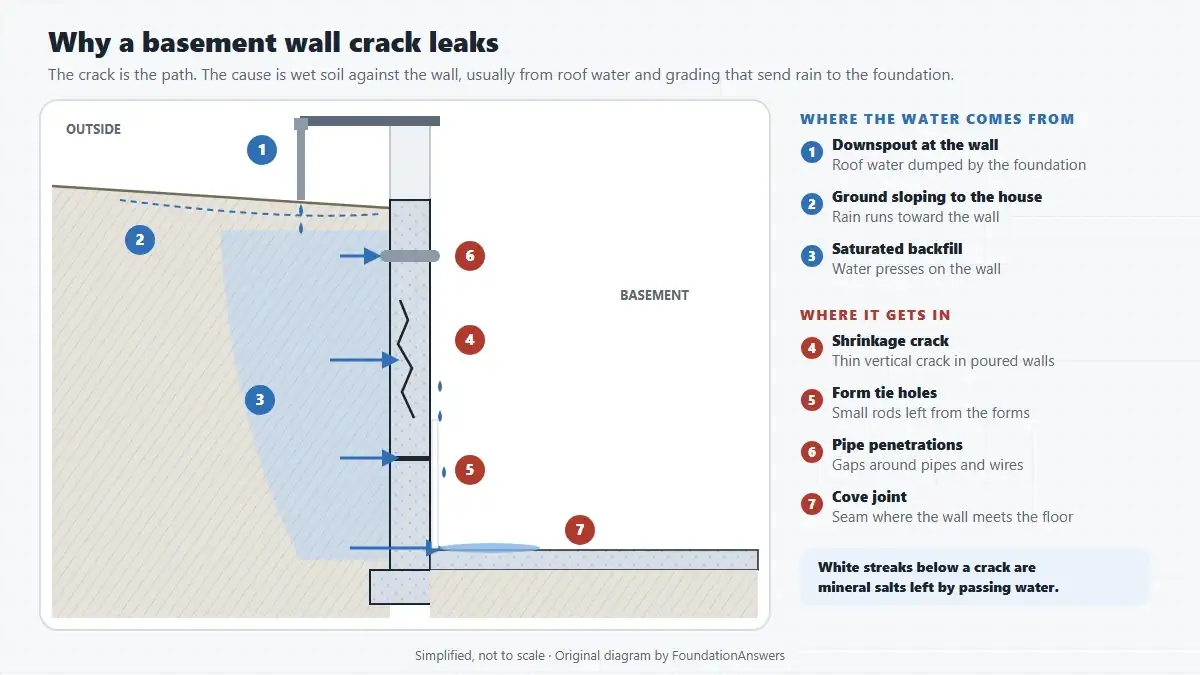
A crack leaks when water sits against the outside of the wall. ASHI guidance says surface drainage problems often cause basement seepage: wet soil from poor drainage causes leaks. Below I am sharing the usual sources of that water.
- Downspouts at the wall: A roof sends a large volume of water to each downspout. Dumped next to the foundation, it soaks the backfill right where cracks are.
- Soil sloping toward the house: Backfill settles over the years, and the ground that once sloped away starts to slope in.
- Clogged gutters: Overflowing gutters drop water along the whole wall.
- Saturated backfill: Loose fill beside the wall holds water like a sponge. Water in the soil pushes on the wall as hydrostatic pressure and forces its way through any opening.
- A failed footing drain: In older houses, the drain pipe along the footing may be clogged or missing.
The water then takes the easiest path in: a shrinkage crack, a form tie hole, a gap around a pipe, or the cove joint where the wall meets the floor.
Is It a Leak or a Structural Crack?
Water does not tell you how serious a crack is, because a harmless crack leaks as easily as a dangerous one. The shape and size do. Below I am sharing how to read the crack in a table.
| What you see | Likely cause | What it means |
|---|---|---|
| Thin vertical crack, poured wall | Concrete shrinkage as it cured | A water path; seal it |
| Vertical crack up to about 1/8 inch | Shrinkage; ASHI notes these can reach 1/8 inch | Usually not structural |
| Water at form tie holes | Rods left from the concrete forms | A water path; plug or inject |
| Water at the wall-floor joint | Groundwater pressure under the slab | A drainage problem, not a crack |
| Stair-step crack in block | Settlement or soil pressure | Check for movement first |
| Horizontal crack | Soil pressure pushing the wall | Structural; engineer before sealing |
| Wide or offset crack | Movement of the wall or footing | Structural; engineer before sealing |
As the table shows, most leaking cracks are only water paths. The ones to take seriously are horizontal, stair-stepped, wide or offset, because they show the wall or footing has moved. ASHI guidance treats movement over 1/2 inch as a potentially serious problem. If the wall also curves inward, read our guide to a bowing basement wall before you seal anything.

Step One: Cut the Water Off Outside
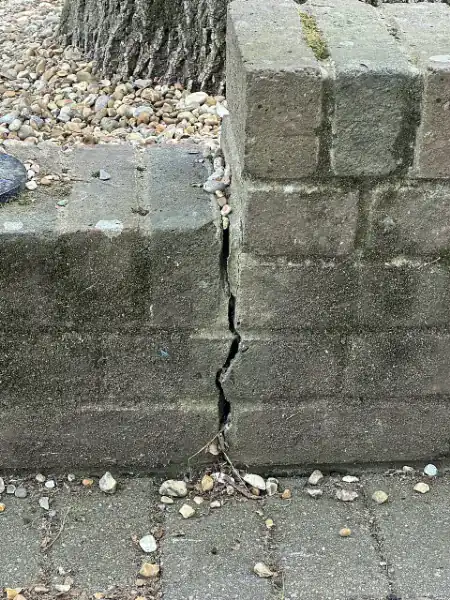
Every leaking crack repair lasts longer when less water reaches the wall. Below I am sharing the outside fixes in order of cost.
- Clean the gutters: Make sure they carry water to the downspouts instead of over the edge.
- Extend the downspouts: Carry roof water well away from the foundation, beyond the backfilled soil.
- Regrade the soil: Build the soil up against the wall so it slopes away from the house. Fixr puts professional regrading at $500 to $3,000.
- Watch the next storm: If the crack stays dry, you may not need any further repair. If it still leaks, seal it.
How to Seal a Leaking Basement Wall Crack
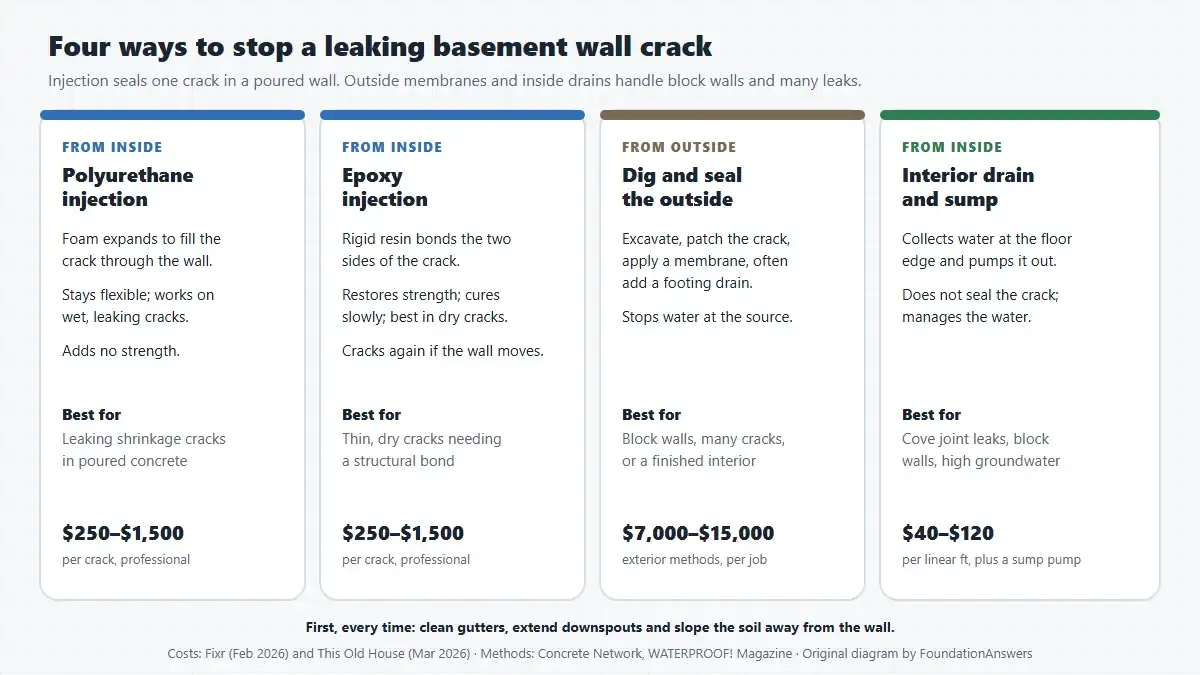
There are four main repairs. Below I am explaining each one and when it fits.
- Polyurethane injection: A crew glues small ports along the crack, seals the surface and pumps in a liquid foam that expands to fill the crack through the full wall. Concrete Network describes it as the choice for stopping leaks or sealing an actively leaking crack, because it sets in minutes and tolerates slight movement. It adds no strength to the wall.
- Epoxy injection: The same method with a rigid resin that bonds the two sides of the crack and restores strength. It cures over hours, works best in dry cracks, and WATERPROOF! Magazine notes low-viscosity epoxy is usually best for hairline cracks under about 2 millimeters.
- Outside excavation and membrane: A crew digs down to the footing, patches the crack from outside and applies a waterproof membrane, often with a new footing drain. This stops water before it reaches the wall and suits block walls and finished basements.
- Interior drain and sump pump: A drain at the floor edge collects water that comes through the wall or the cove joint and pumps it out. It does not seal the crack; it manages the water.
Concrete Network notes that injection is not a fix for hollow masonry block walls, and that water entering at the seam between the wall and the floor points to a water table problem rather than a crack. Both cases call for outside work or an interior drain.

How Crack Injection Works
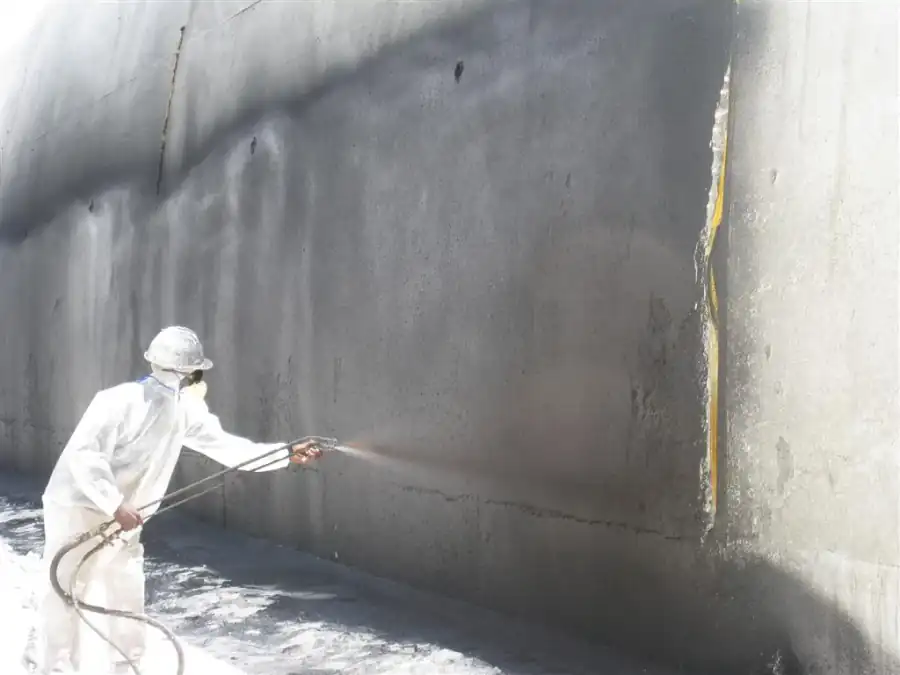
Injection is the most common repair for a leaking crack in a poured wall. Below I am sharing the steps, based on manufacturer guidance reported by Concrete Network.
- Clean the crack face: Remove paint, dirt and loose concrete along the crack.
- Set the ports: Space surface ports about one inch apart for each inch of wall thickness.
- Seal the surface: Cover the crack between the ports with a paste that cures in about 20 to 45 minutes.
- Inject from the bottom up: Pump the material at about 20 to 40 psi into the lowest port until it appears at the next one, then move up.
- Let it cure: Wait 24 to 48 hours, then cut off the ports.
Example: Suppose a vertical crack runs 7 feet up an 8-inch-thick poured wall. Ports go about 8 inches apart, so 84 inches of crack takes about 11 ports. Injected from the bottom up, the foam fills the crack all the way to the soil side, which is why a good injection stops a leak that surface patches could not.
Leaking Basement Wall Crack Repair Cost
Below I am sharing typical 2026 prices for each repair in a table.
| Repair | Typical cost | Source |
|---|---|---|
| Crack injection, per crack | $250–$1,000 | Fixr, Feb 2026 |
| Epoxy injection, per crack | $800–$1,500 | This Old House, Mar 2026 |
| Foundation leak repair | About $250 (small crack) to $10,000 (major problem) | This Old House, Mar 2026 |
| Exterior methods, per job | $7,000–$15,000 | This Old House, Mar 2026 |
| Interior perimeter drain | $40–$120 per linear ft | Fixr, Feb 2026 |
| Sump pump | $600–$2,500 | Fixr, Feb 2026 |
| Regrading soil | $500–$3,000 | Fixr, Feb 2026 |
| Gutters and downspouts | $3–$30 per linear ft | Fixr, Feb 2026 |
As the table shows, sealing one crack from inside costs a few hundred to about fifteen hundred dollars, while outside excavation runs into five figures. That gap is why the outside drainage fixes and a single injection come first. Compare the larger jobs with our guide to basement waterproofing cost before you sign for a full system.
So, Which Fix Is Right for Your Wall?
The right fix depends on the wall and the crack.
- If it is a thin vertical crack in a poured wall: Fix the gutters and grading, then inject it, usually with polyurethane.
- If water comes through form tie holes: Plug or inject each hole the same way.
- If the wall is concrete block: Skip injection. Use outside sealing or an interior drain, and check the wall for stair-step cracks and bowing.
- If water enters at the wall-floor joint: Treat it as groundwater. An interior drain and sump pump is the usual fix.
- If the crack is horizontal, wide, offset or growing: Get a structural engineer's assessment first. Seal it only after the movement is understood or stopped.
- If many cracks leak or the basement is finished: Outside excavation and a membrane may cost less overall than repairing crack after crack.
Common Mistakes to Avoid With a Leaking Crack
- Sealing before fixing the drainage: The water finds the next crack or joint.
- Surface patching only: Caulk or hydraulic cement on the inside face leaves the crack full of water behind it.
- Injecting a block wall: The material disappears into the hollow cores.
- Sealing a moving crack: Hiding a horizontal or widening crack removes the evidence an engineer needs.
- Buying a full system for one crack: A single leaking shrinkage crack rarely needs a perimeter drain.
Conclusion
A basement wall crack that leaks is usually a shrinkage crack with wet soil behind it. Fix the gutters, downspouts and grading first, because they cut the water that drives the leak. Then seal a poured-wall crack with injection from inside, for about $250 to $1,500 per crack, and use outside sealing or an interior drain for block walls and wall-floor leaks. Treat horizontal, wide or offset cracks as structural and get an engineer before you seal them. For more help with your foundation, browse our clear answers on cracked and leaking foundation walls.
Frequently Asked Questions
-
When should I worry about a leaking basement wall crack?
Worry about the crack itself, beyond the water, when it is horizontal, stair-stepped in a block wall, wider than about 1/4 inch, offset so one side sits further out, or paired with a wall that bows. ASHI guidance treats wall movement of 1/2 inch or more as a potentially serious problem. A thin vertical crack that only leaks is usually a water problem with a simple fix.
-
How much does it cost to fix a leaking basement wall crack?
Professional injection of one crack costs about $250 to $1,000 according to Fixr and about $800 to $1,500 according to This Old House, both in 2026. Exterior excavation and waterproofing costs about $7,000 to $15,000 per job, and an interior drain costs about $40 to $120 per linear foot plus a sump pump.
-
Can you fix a leaking basement wall crack from the inside?
Yes, for a crack in a poured concrete wall. Injection from the inside fills the crack through the full wall thickness, so water cannot travel through it. Polyurethane foam suits wet, leaking cracks. Injection does not work on hollow concrete block walls, and it does not stop water entering at the joint between the wall and the floor.
-
Will hydraulic cement stop a leaking crack?
Often only for a while. A surface plug seals the inside face of the crack, but water still fills the crack behind it and pushes against the plug, and the concrete keeps moving slightly with temperature and moisture. Injection fills the full depth of the crack, and fixing the water outside reduces the pressure that drives the leak.
-
Does homeowners insurance cover a leaking basement wall crack?
Usually not. Policies generally exclude gradual seepage, cracking and settling, and flooding needs a separate flood policy. Insurers may pay for sudden water damage from a burst pipe. The repair of the crack itself is normally treated as maintenance, so expect to pay for it yourself and check your policy wording.
-
Is a leaking crack a sign of a structural problem?
Not by itself. Water follows any path, so a harmless shrinkage crack leaks as easily as a structural one. The shape and size of the crack tell you more than the water: vertical and thin is usually shrinkage; horizontal, stair-stepped, wide, offset or growing points to movement that needs an engineer before any sealing.
Sources and Standards
- Feiza, T., American Society of Home Inspectors, Basement cracks and leaks, ASHI Reporter.
- Concrete Network, Concrete crack injection: epoxy and polyurethane.
- Schmid, J., WATERPROOF! Magazine, Epoxy or polyurethane foam?, April 2010.
- Fixr, basement waterproofing cost, updated February 6, 2026.
- This Old House, basement waterproofing cost, updated March 4, 2026.
- Policygenius, Does homeowners insurance cover mold? (gradual leaks and flooding excluded), updated May 2022.
This guide is general information and does not replace an on-site inspection by a qualified professional. Read our disclaimer.