Diagnosis guideFoundation Cracks
Crack in a Basement Wall: What Each Type Means and What to Do
Some cracking is normal in a basement wall. The direction of the crack, the type of wall and whether it is still moving tell you if you can seal it or should call an engineer.
A crack in a basement wall is a break in the poured concrete or concrete block that forms the wall of your foundation. Most are thin shrinkage cracks that appeared as the concrete dried, while a smaller number show that soil pressure or settlement is moving the wall. This guide is part of our foundation cracks hub, which covers every type of crack in a foundation.
If you have just noticed a line on your basement wall and your mind went straight to the cost of a new foundation, you are not alone. The good news is that the concrete industry's own guidance says some cracking is normal. In this guide I will explain how to read a crack by its direction and by the type of wall, what often gets mistaken for a crack, how to check it yourself, what each repair costs, and when you should call a structural engineer.
Short answer
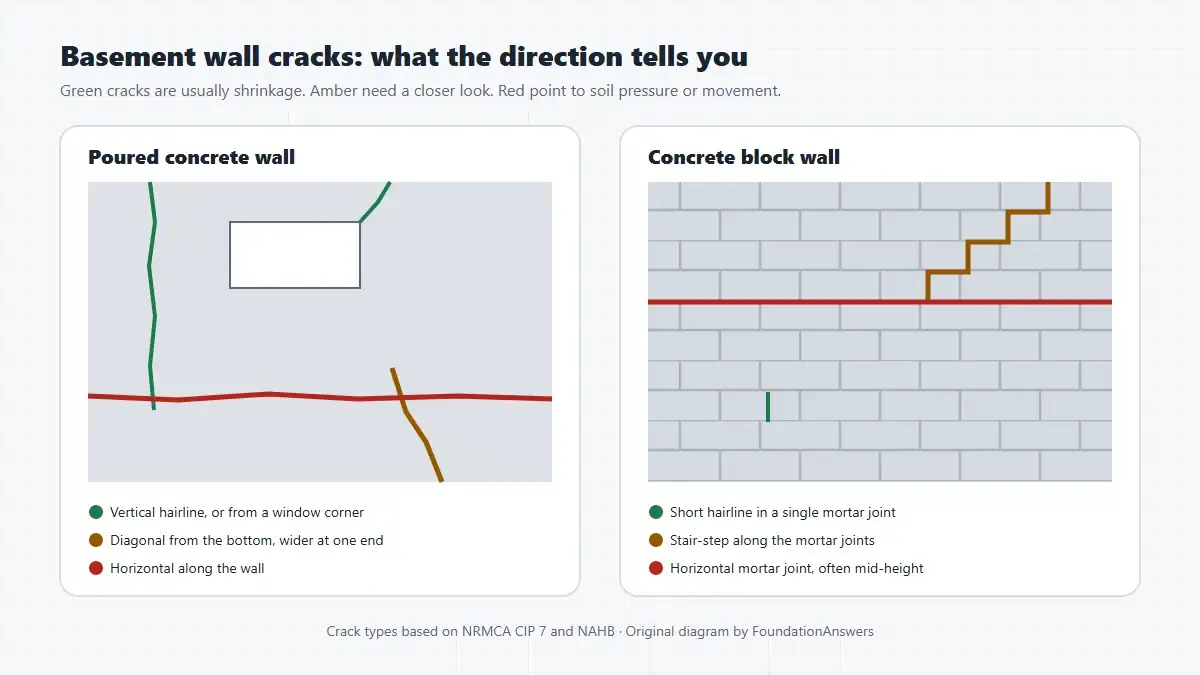
A thin vertical crack in a poured concrete wall is usually harmless shrinkage, even if it leaks. Horizontal cracks are the most serious, because they usually mean soil pressure is pushing the wall inward. Stair-step cracks in block walls, tapered cracks, cracks wider than about 1/4 inch, and any wall that bows or leans need a structural engineer. Mark the crack and check it over time.
Usually fine
Thin, vertical and stable
Shrinkage cracks and cracks from window corners. Seal them if they leak.
Monitor
Diagonal or unsure
Mark the ends and width, then recheck through the seasons.
Call an engineer
Horizontal, offset or bowing
These point to pressure or movement, which sealing will not fix.
Why Do Basement Walls Crack?
Basement walls hold back soil while they carry the house, and concrete itself changes size as it cures. The NRMCA guide CIP 7, Cracks in Residential Basement Walls, lists the usual causes. Below I am sharing them in plain terms.
- Drying shrinkage and temperature: Fresh concrete is at its largest volume. It shrinks as it dries, and it cracks when the footing or the rest of the wall stops it from moving.
- Corners of openings: Shrinkage stress gathers at the corners of windows and doors, so short diagonal cracks start there.
- Settlement: Uneven support under the footing, or expansive soil, can move part of the wall.
- Backfilling damage: Heavy equipment close to a young wall, or backfill pushed in before the wall is braced, can crack it during construction.
- Soil and water pressure: Wet soil and frost press on the wall from outside. CIP 7 notes that existing cracks can grow under these continued horizontal pressures.
What Do the Different Basement Wall Cracks Mean?
The same line can mean different things in poured concrete and in block, because the two materials fail differently. Below I am sharing what each direction usually means in a table.
| Crack | Poured concrete wall | Concrete block wall | How serious? |
|---|---|---|---|
| Vertical | Usually shrinkage, often near mid-wall or a form line | Less common; may follow vertical mortar joints | Low if thin and stable |
| Diagonal from a window corner | Usually shrinkage at the corner | May step through the joints below the window | Low if thin and stable |
| Diagonal from the base or a corner | Possible settlement or heave | Appears as a stair-step crack | Medium; monitor or get checked |
| Stair-step | Does not apply | Uneven settlement or soil pressure | Medium to high |
| Horizontal | Soil pressure; less common | Soil pressure, often along a mid-height joint | High; call an engineer |
As the table shows, direction is the first clue and the wall material is the second. Online advice often disagrees about diagonal cracks, and the reason is simple. A diagonal crack that starts at a window corner is usually shrinkage, while a diagonal crack that runs from the base of the wall and widens toward one end can be a sign that part of the foundation has moved.

Things That Look Like a Crack but Are Not
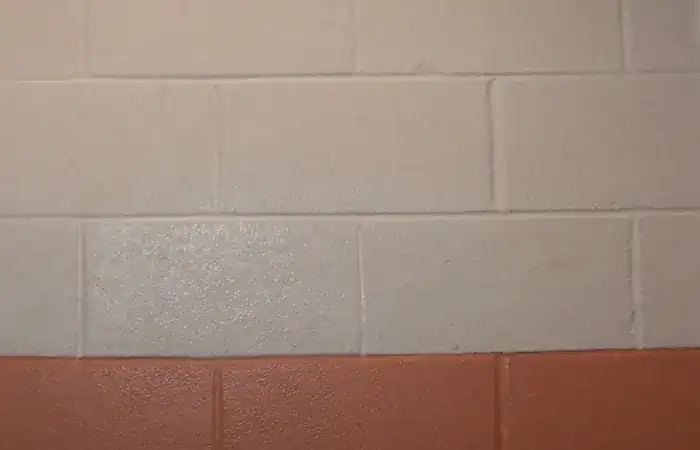
Poured walls carry several marks from construction that worry new owners. CIP 7 explains most of them. Below I am sharing the look-alikes to rule out first.
- Pour lines: A visible line between two loads of concrete. It usually runs roughly level and is often mistaken for a crack, although a delayed pour can leave a weak cold joint.
- Form lines: Straight vertical or horizontal ridges where the form panels met.
- Form tie marks: Small round or square spots in rows, left by the ties that held the forms together.
- Crazing: A fine web of surface lines that comes from poor curing and does not go through the wall.
- Efflorescence: White powder that traces where water has been. It is a moisture clue and not a crack.
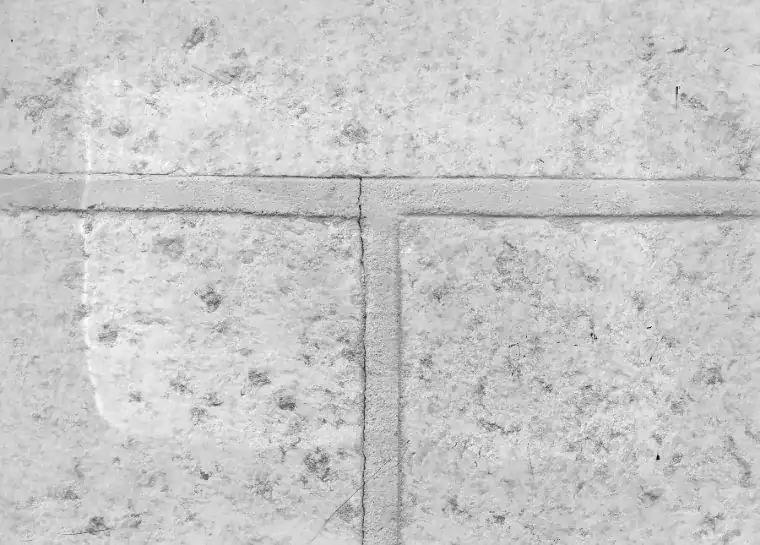
If a line is perfectly straight and level across the whole wall, it is more likely a form or pour line than a horizontal crack. Check whether you can fit a thin card into it, and whether it has the rough, broken edge that a real crack has.
How to Check a Crack in Your Basement Wall
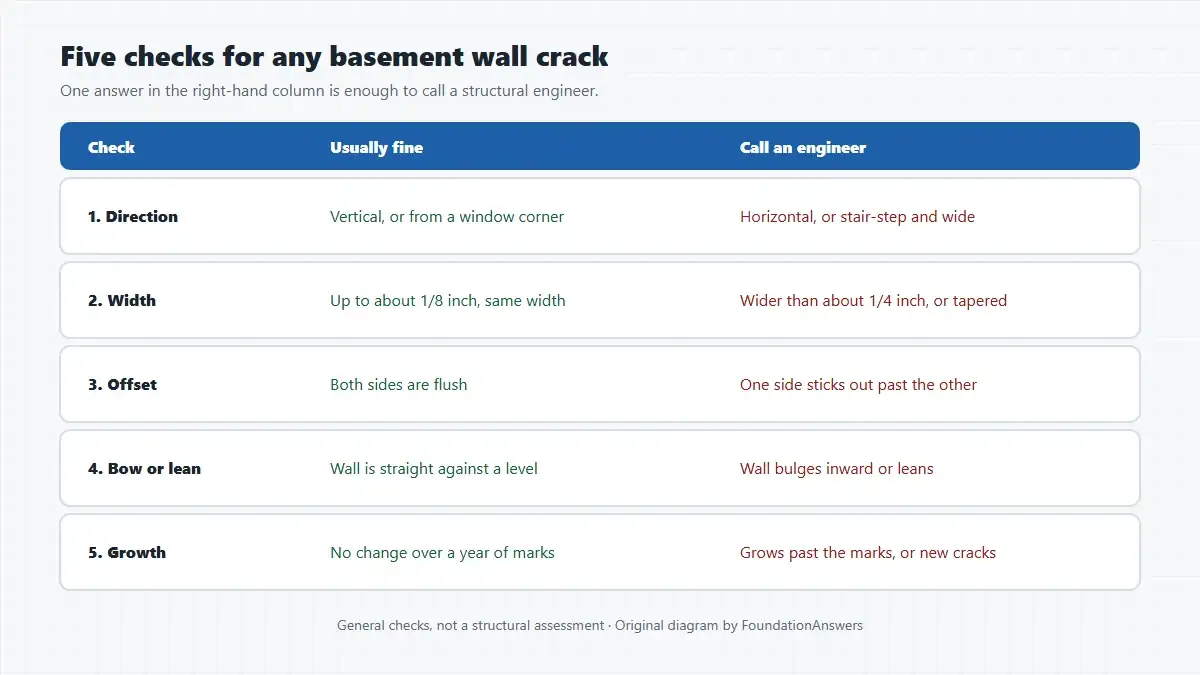
You can learn a lot in ten minutes with simple tools. Below I am sharing five checks to make.
- Direction: Note whether the crack runs vertically, diagonally, horizontally or in steps.
- Width: Measure it at the widest point. CIP 7 says a typical builder warranty requires repair when a crack is wider than 1/8 inch, and NAHB's guidelines treat masonry cracks over 1/4 inch as items for repair.
- Offset: Run a finger across the crack. One side sticking out past the other means the wall has moved.
- Bow or lean: Hold a long level or a tight string against the wall, and look for a bulge near the crack. Our bowing basement wall guide shows how to measure it.
- Growth: Draw a pencil line across each end, write the date, take a photo with a ruler in the frame, and recheck every few months for a year.
Example: Suppose your six-year-old house has a 1/16-inch vertical crack running from the top of a poured wall to the floor. The two sides are flush, the wall is straight, and your pencil marks show no change after a year. That crack passes all five checks. It is a shrinkage crack, and the only reason to treat it is if it leaks.
Example: Now suppose a block wall in a 40-year-old house has a crack along a joint at mid-height, and a level shows the wall bulging inward near it. It fails on direction and on bow, so it needs an engineer even if the crack is only 1/8 inch wide.

How Are Basement Wall Cracks Repaired?
The right repair depends on whether the crack lets in water or the wall is moving. Below I am sharing the main options with typical prices in a table.
| Repair | Best for | Typical cost | Source |
|---|---|---|---|
| Crack filling | Dry, stable cracks | $250–$800 | This Old House, Oct 2026 |
| Crack injection | Leaking cracks in poured walls | $250–$1,000 per crack | Fixr, Feb 2026 |
| Epoxy injection | Bonding a stable poured crack | $800–$1,500 per crack | This Old House, Mar 2026 |
| Carbon fiber straps | Small bows in a wall | $2,000–$5,000 | Modernize, Aug 2026 |
| Wall anchors | Moderate bows, with room in the yard | $3,000–$8,000 | Modernize, Aug 2026 |
| Engineer's inspection | Any crack you are unsure about | About $600 ($300–$1,000) | This Old House, 2026 |
As the table shows, sealing a crack costs hundreds of dollars and stabilizing a wall costs thousands. Those are different jobs, and one cannot replace the other. If water is your only problem, our guide to a basement wall crack leaking water explains how to stop it, starting with the drainage outside.
When Should You Call a Structural Engineer?
An engineer is independent of the repair, which matters when a contractor is offering to sell it. Below I am sharing the signs that justify the visit.
- Any horizontal crack: Especially in a block wall, or with a bulge beside it.
- A stair-step crack wider than about 1/4 inch: Or one that is growing.
- An offset: Any crack with measurable displacement.
- A wall that bows or leans: Even if the crack looks small.
- Signs upstairs: Sticking doors, sloping floors or cracks in the walls above the same spot.
- A crack that returns: A crack that reopens after patching is still moving.
If you are not sure who to call, our guide to the structural engineer vs home inspector explains what each one does.
So, Is Your Basement Wall Crack Serious?
The answer depends on what you found.
- If it is a thin vertical crack in a poured wall: It is rarely serious. Monitor it, and seal it if it leaks.
- If it starts at a window corner: It is usually shrinkage. Treat it the same way.
- If it is a stair-step crack in block: Measure and monitor it, and call an engineer if it is wide or growing.
- If it is horizontal: Treat it as structural until an engineer says otherwise.
- If you are buying the house: Ask when it appeared and whether it has been patched, and have any horizontal or wide crack assessed before your contingency ends.
- If the house is new: Report it to the builder, as a typical warranty covers cracks that leak, show displacement or exceed 1/8 inch.
What You Should Do: Run the five checks today, mark the crack, and take a dated photo. That record is useful to you, to an engineer and to any future buyer.
Common Mistakes to Avoid With Basement Wall Cracks
- Sealing before you monitor: Filler hides the movement that an engineer needs to see.
- Judging by width alone: A thin horizontal crack can matter more than a wider vertical one.
- Painting over it: Waterproof paint hides the crack and does not stop a moving wall.
- Accepting a free diagnosis as final: A company that sells repairs is not an independent source.
- Ignoring the water outside: Gutters, downspouts and grading are the cheapest way to reduce pressure on the wall.
- Forgetting radon: EPA lists cracks as a way radon can enter a house, so test if you have not done so.
Conclusion
A crack in a basement wall is usually a thin shrinkage crack, particularly when it is vertical or starts at a window corner. Horizontal cracks, wide stair-step cracks, offsets and bowing walls are different, because they point to soil pressure or movement. Check the direction, width, offset, bow and growth, keep a dated record, and call a structural engineer before you pay for a major repair. For more help, browse our plain answers for cracked walls and worried homeowners.
Frequently Asked Questions
-
When should I worry about a crack in my basement wall?
Worry when a crack is horizontal, stair-stepped and wide, wider at one end, wider than about 1/4 inch, or offset so one side sticks out. Also worry when the wall bows or leans, or when the crack keeps growing. A dry vertical hairline crack that stays the same is usually a shrinkage crack.
-
Is it common for basement walls to crack?
Yes. The concrete industry guide CIP 7 says some cracking is normal in concrete basement walls, because concrete shrinks as it dries and moves with temperature. Most of these cracks appear early in the life of the wall, are thin and do not affect its strength, although they can still leak.
-
Can I fix basement wall cracks from the inside?
You can seal many of them from the inside. Injection from inside the basement is a common repair for leaking cracks in poured concrete walls. It works less well in hollow block walls. Injection stops water but does not fix a wall that is moving, so structural cracks need an engineer first.
-
Does homeowners insurance cover cracked basement walls?
Usually not. Triple-I notes that most US property policies exclude earth movement, and standard policies also exclude settling and the cracking it causes. A covered event, such as a burst pipe or a vehicle strike, may be different. Ask your insurer before you begin repairs.
-
How much does it cost to repair a crack in a basement wall?
Crack filling usually costs $250 to $800, and injection costs about $250 to $1,000 per crack. Epoxy injection can reach $800 to $1,500. A bowing wall that needs straps or anchors costs about $2,000 to $8,000. An engineer's inspection, at about $600, tells you which repair you need.
-
Should I fill a basement wall crack myself?
A dry, stable hairline crack can be sealed with a DIY kit, mainly to keep out water and soil gas. Do not fill a crack that is widening, offset or horizontal, because filler hides the movement. Mark and photograph the crack first, so you still have a record of it.
Sources and Standards
- National Ready Mixed Concrete Association, CIP 7, Cracks in Residential Basement Walls.
- National Association of Home Builders, W. Keaveny, PE, Misconceptions about the common crack, January 2018.
- This Old House, Foundation repair cost, updated October 2026.
- This Old House, Basement waterproofing cost, updated March 2026.
- This Old House, How much does a foundation inspection cost?, 2026.
- Fixr, Basement waterproofing cost, updated February 2026.
- Modernize, Bowing basement wall repair cost, updated August 2026.
- Insurance Information Institute, Sinkholes and insurance (earth movement exclusion).
- US Environmental Protection Agency, A citizen's guide to radon.
This guide is general information and does not replace an on-site inspection by a qualified professional. Read our disclaimer.