Diagnosis guideWater Damage
Wood Floor Water Damage: Can Your Floor Be Saved, and What Will It Cost?
Read the shape of the boards, dry the floor the right way, wait for the moisture readings, then decide between saving, refinishing and replacing.
Wood floor water damage is any change in a wood floor caused by too much moisture, from a white haze in the finish to boards that cup, crown, buckle, stain or rot. It happens when water sits on top of the floor or soaks into it from below, through a leak, a flood or a damp crawl space or basement. This guide is part of our water damage hub, where every problem is traced to its source before any repair is priced.
If you just found wavy boards after a dishwasher leak, or a dark patch near a radiator or a door, you are not alone in wondering whether the whole floor has to go. Most homeowners assume the worst, yet many wet wood floors flatten again once they dry. In this guide I will explain how to read the shape of the boards, what to do in the first 48 hours, how to dry and measure the floor, when it can be saved, and what refinishing or replacing it costs.
Short answer
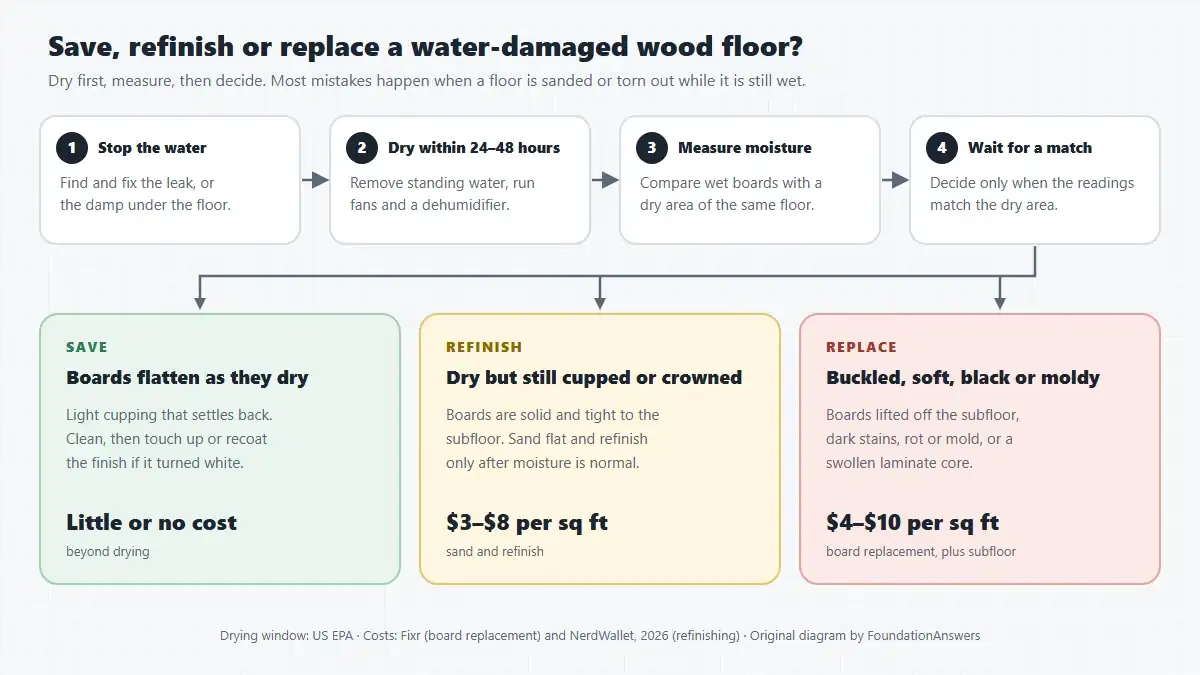
Stop the water and dry the floor within 24 to 48 hours, as the US EPA advises for any water-damaged material. Then wait for the moisture readings to match a dry area of the floor before you decide. Cupped boards often flatten; dry boards that stay cupped can be sanded and refinished for about $3 to $8 per square foot; buckled, black or moldy boards need replacing.
Likely savable
Light cupping
Edges slightly raised, boards still tight to the subfloor, no dark stains.
Refinish
Stays cupped when dry
Solid boards that keep their shape after the readings return to normal.
Replace
Buckled or black
Boards lifted off the subfloor, soft spots, black stains or mold.
Why Does Water Damage a Wood Floor?
Wood swells as it takes on moisture and shrinks as it dries. A Purdue Extension guide, based on the US Forest Service Wood Handbook, notes that lumber for interior use is normally dried to about 6 to 8 percent moisture content. A floor installed at that level stays flat while the house stays within a normal humidity range. When one side of the boards gets much wetter than the other, that side swells more, and the boards change shape.
Water reaches a floor in two ways. It lands on top, from a spill, a leaking appliance, a pet bowl or a flood. Or it rises from below, from a plumbing leak under the floor, a wet slab or a humid crawl space or basement. The direction matters, because it decides which way the boards bend and where you look for the cause.
Signs of Water Damage on a Wood Floor
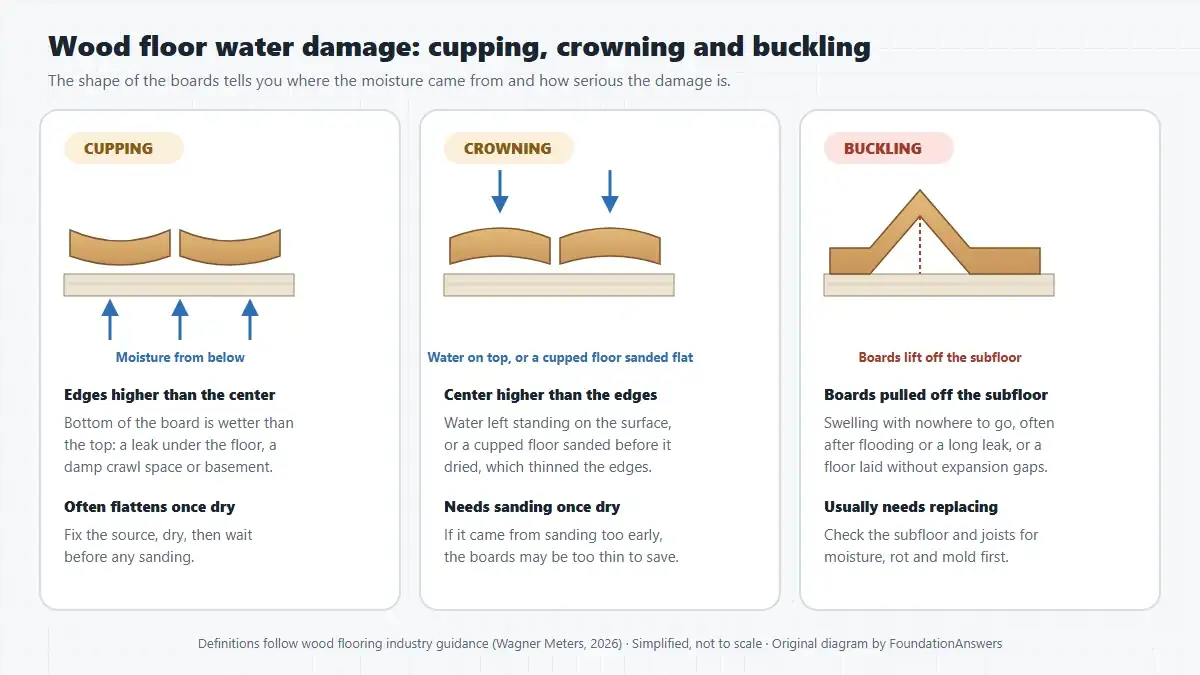
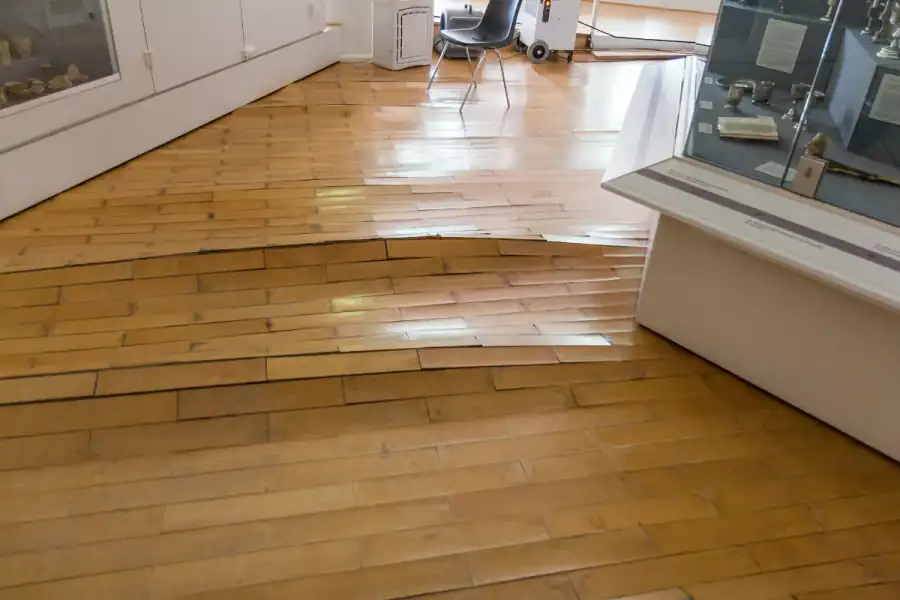
The shape and color of the boards tell you most of what you need to know. Below I am sharing the common signs, what each one means and how serious it is in a table.
| Sign | What you see | Likely cause | How serious |
|---|---|---|---|
| White haze or rings | Cloudy marks in the finish | Water trapped in the finish layer | Low: finish only |
| Cupping | Board edges higher than the center | More moisture below than above | Medium: often reverses once dry |
| Crowning | Center higher than the edges | Water on top, or a cupped floor sanded too early | Medium: needs sanding once dry |
| Gaps and cracks | Wider joints after drying | Boards shrank after swelling | Low to medium |
| Buckling | Boards lifted off the subfloor | Severe swelling with no room to expand | High: usually replace |
| Dark or black stains | Gray to black patches in the wood | Long-term moisture, often under rugs or near leaks | High: stain goes deep |
| Soft or spongy spots | Floor gives underfoot | Rot in the boards or the subfloor | High: check the structure |
| Musty smell | Odor near the floor or vents | Mold under the floor | High: find and dry the source |
As the table shows, shape changes are mostly about moisture and often reverse, while dark stains, soft spots and smells point to longer exposure and deeper damage. A floor can show several signs at once, so check the whole room as well as the obvious patch.

What to Do in the First 48 Hours
The US EPA says to dry water-damaged areas and items within 24 to 48 hours to prevent mold growth. Below I am sharing the steps in the order that matters.
- Stop the water: Shut off the supply to the leaking appliance or the main valve, and turn off power to any wet outlets.
- Remove standing water: Use towels or a wet vacuum. Do not let water sit on the boards.
- Lift rugs and move furniture: Rugs and rug pads trap moisture against the wood and cause dark stains.
- Start drying: Run fans across the floor and a dehumidifier with the room closed. Open a window only if the outside air is drier.
- Take photos: Record the damage and the source before anything is removed, for your insurer and your contractor.
- Check below: If there is a crawl space or basement under the floor, look for wet subfloor, dripping water or damp insulation.
Do not sand, nail down or tear out boards in these first days. Swollen wood that looks ruined on day one can settle back once it dries.
How to Dry and Measure a Wet Wood Floor
Drying is complete when the wet boards read the same as the dry ones, not when the surface feels dry. A moisture meter gives you that answer. Pin meters push two small pins into the wood, and pinless meters read through the surface without leaving holes.
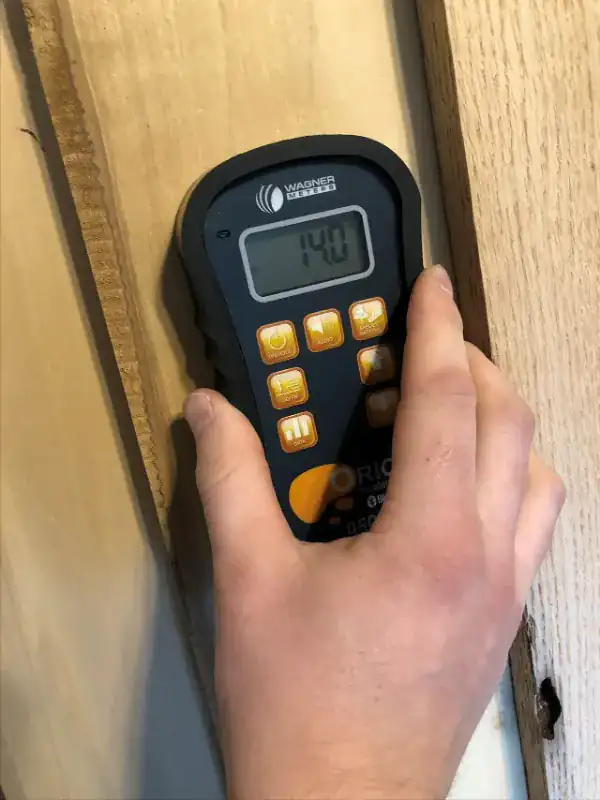

- Find a dry reference: Read several boards in a part of the same floor that stayed dry. That is your normal number.
- Map the wet area: Read the damaged boards in a grid and mark the highest readings with painter's tape.
- Read the same spots daily: Write the numbers down. Falling readings show the drying is working.
- Check the subfloor: From the crawl space or basement, or through a removed board, read the subfloor too. Wet plywood underneath keeps feeding moisture into the boards.
- Decide only when they match: Wagner Meters, a moisture meter maker, advises confirming that moisture has returned to normal before deciding on any sanding.
Example: Suppose your dry hallway boards read 8% and the kitchen boards next to a leaking dishwasher read 17% on day one, 13% on day four and 9% on day nine. On day nine the kitchen is close to normal. If the boards have flattened, you are done; if they still show cupping, that is the point to plan a refinish, not day one.
Can a Water-Damaged Wood Floor Be Saved?
Whether a floor can be saved depends on the type of floor and how long it stayed wet. Below I am explaining the outcome for each common floor type.
- Solid hardwood: The best chance of saving. Thick boards can be sanded several times, so a dry floor that stays cupped can usually be sanded flat.
- Engineered wood: A thin real-wood layer sits on a plywood base. Light cupping can settle, but a thin top layer limits sanding, and a soaked base can separate into layers.
- Laminate: A printed layer over a fiberboard core. The core swells when it soaks up water and usually stays swollen, so damaged planks are normally replaced.
- Any floor with rot or mold: Boards that went soft, black or moldy, or a subfloor that did, need to come out so the structure can dry and be repaired.
The source decides the long-term result. A floor that cupped from a damp crawl space will cup again if the crawl space stays damp, so read our guide to moisture in a crawl space if your floor sits over one.
Wood Floor Water Damage Repair Cost
Repair cost depends on the damage and the method. Below I am sharing typical national prices for each repair in a table.
| Repair | Typical cost | When you need it |
|---|---|---|
| Cupped or buckled floor repair | $3–$8 per sq ft | Shape damage, boards still sound |
| Sand and refinish | $3–$8 per sq ft | Dry boards still cupped, crowned or stained on the surface |
| Board replacement | $4–$10 per sq ft | Buckled, black, split or rotted boards |
| Water damage repair, overall | $8–$100 per sq ft | Ranges from small patches to subfloor work |
| Mildew on the floor | $10–$25 per sq ft | Surface mildew; a mold specialist adds $500–$3,000 |
| Rot repair | $50–$250 per sq ft | Rotted boards, subfloor or joists |
| Plumbing visit to find a leak | $150–$400 | Source not obvious |
As the table shows, a floor that only changed shape costs a few dollars per square foot to put right, while rot and mold push the price far higher. Fixr's data puts the average hardwood repair at about $2,000, for about 200 square feet of moderate damage. Refinishing prices come from Fixr and NerdWallet's 2026 guide, which both give $3 to $8 per square foot.
Example: Suppose a dishwasher leak buckles 40 square feet of oak strip floor in a 200 square foot kitchen. Replacing the buckled boards costs about 40 × $4–$10 = $160 to $400. New boards rarely match the old finish, so most owners refinish the whole room to blend them: 200 × $3–$8 = $600 to $1,600. The total lands at about $760 to $2,000, before any subfloor repair.
So, Should You Repair or Replace Your Wood Floor?
The right choice depends on what you find once the floor is dry.
- If the boards flattened: Clean the floor and fix the finish where it turned white. You do not need a flooring contractor.
- If dry boards stay cupped or crowned but feel solid: Sand and refinish. Ask the contractor to confirm the moisture readings before sanding starts.
- If a small area buckled or turned black: Replace those boards and refinish the room so the repair blends in.
- If the subfloor is soft, moldy or the floor bounces: Open the floor and have the subfloor and joists checked before you choose new flooring.
- If you have laminate: Replace the swollen planks, and dry the subfloor before the new ones go down.
Common Mistakes to Avoid With a Wet Wood Floor
- Sanding too early: A cupped floor sanded before it dries turns into a crowned floor with thin edges.
- Leaving rugs down: A wet rug pad keeps the boards wet and leaves dark stains.
- Drying with heat alone: Hot, dry air on the surface while the bottom stays wet makes the boards bend the other way.
- Ignoring the source: A floor over a damp crawl space or a slow leak will cup again after any repair.
- Tearing out a savable floor: Many cupped floors flatten in days to weeks. Measure before you replace.
Conclusion
Wood floor water damage looks worse on day one than it often is. Stop the water, dry the floor within 24 to 48 hours, and measure until the wet boards match a dry area before you decide anything. Boards that flatten need little work, dry boards that stay cupped can be sanded and refinished for about $3 to $8 per square foot, and buckled, black or moldy boards need replacing. Fix the source, whether a leak or a damp space below, so the repair lasts. When you want to read more, browse our engineer-checked guides to floors, leaks and water damage.
Frequently Asked Questions
-
Can water-damaged wood floors be fixed?
Often, yes. Solid hardwood that cupped from moisture underneath frequently flattens once the source is fixed and the floor dries. If the boards stay cupped or crowned but remain solid and tight, sanding and refinishing usually saves them. Boards that buckled off the subfloor, turned black, went soft or grew mold normally need replacing.
-
How long does it take hardwood floors to dry out after water damage?
There is no fixed time. A small spill caught early can dry in days, while a floor soaked from below by a long leak or a damp crawl space can take weeks. Measure instead of guessing: compare moisture meter readings on the wet boards with a dry area of the same floor, and wait until they match.
-
What pulls moisture out of wood floors?
Moving, dry air does the work. Remove standing water, run fans across the floor, and run a dehumidifier with the room closed so the air stays dry. Professional restorers also use mats that draw air through the boards. Heat speeds drying, but fast drying from the top alone can over-dry the surface and cause crowning.
-
How much does it cost to repair a water-damaged hardwood floor?
Fixr puts water-damaged hardwood repair at about $8 to $100 per square foot, with most whole repairs averaging about $2,000 for 200 square feet of moderate damage. Refinishing alone costs about $3 to $8 per square foot, and replacing boards costs about $4 to $10 per square foot before any subfloor work.
-
Should I sand a cupped floor right away?
No. Sanding a cupped floor while it is still wet cuts the raised edges flat. When the boards then dry, the edges shrink below the center and the floor crowns, and the thinner edges can no longer be sanded again. Fix the source, dry the floor and confirm normal moisture readings first.
-
Can a water-damaged laminate floor be saved?
Rarely. Laminate has a fiberboard core that swells when it soaks up water, and the swelling usually stays after it dries. Planks with lifted or swollen edges normally need replacing. Wipe up spills fast, and if water got under the floor, lift the planks so the subfloor can dry.
Sources and Standards
- US EPA, A Brief Guide to Mold, Moisture and Your Home, updated February 18, 2026.
- Wagner Meters, Cupping and crowning: spotting trouble in your wood floors, updated October 26, 2026.
- Purdue Extension, FNR-403-W, wood moisture content (based on the USDA Forest Service Wood Handbook).
- Fixr, hardwood floor repair cost, updated January 31, 2025.
- NerdWallet, cost to refinish hardwood floors in 2026.
This guide is general information and does not replace an on-site inspection by a qualified professional. Read our disclaimer.