Diagnosis guideFoundation Cracks
Horizontal Crack in a Basement Wall: Why It Is Serious and What to Do
Most basement cracks are harmless. A horizontal crack is the exception, because it usually means the soil outside is bending the wall. Here is how to measure it and what to do first.
A horizontal crack in a basement wall is a crack that runs level along the wall, usually through a mortar joint in block or across a poured concrete wall. It matters because it usually shows that soil pressure from outside is bending the wall inward. This guide is part of our foundation cracks hub, which explains every type of foundation crack and when each one matters.
If you have found a long level crack in your basement and searched for it late at night, you have probably seen some frightening answers, and you are not alone. A horizontal crack deserves attention, but it is not always an emergency, and many walls can be repaired without rebuilding them. In this guide I will explain why these cracks form, how to measure the wall, what to do first, what the repairs cost, and what it means if you are buying the house.
Short answer
A horizontal crack in a basement wall usually means soil pressure is pushing the wall inward, so it should be assessed by a structural engineer even if it looks thin. Measure the crack and check the wall for bowing with a string or level. A crack over 1/8 inch with about 1/2 inch or more of inward movement generally needs repair. Fix the water outside first, and do not simply seal the crack.
Lower concern
Thin, and the wall is straight
Have it assessed once, fix the drainage and keep measuring.
Act soon
Slight bow
An early repair is often the cheapest one. Book an engineer.
Urgent
Sliding or fast movement
Blocks have shifted or the crack is growing quickly. Call now.
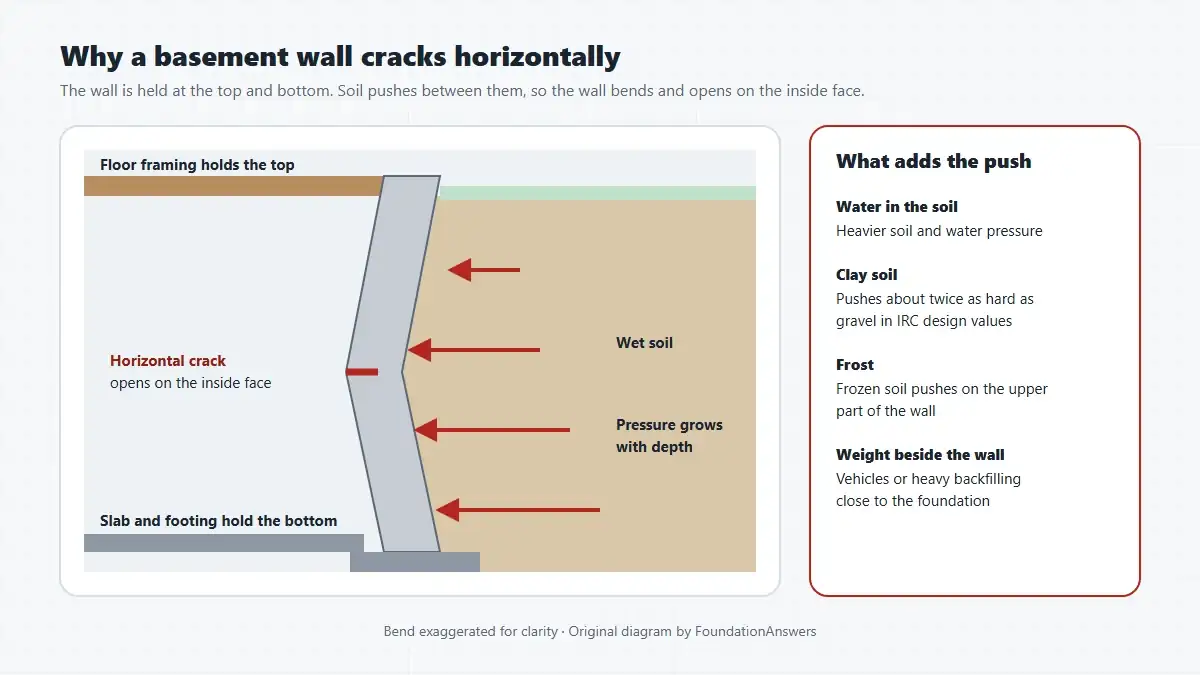
Why Is a Horizontal Crack More Serious Than Other Cracks?
Most basement cracks come from concrete shrinking as it dries, and they run vertically. A horizontal crack has a different cause. As our guide to a crack in a basement wall explains, direction is the first clue, and this is the direction that points to outside pressure.
A basement wall behaves like a short beam standing on end. The floor framing holds the top, the footing and slab hold the bottom, and the soil pushes on the span between them. When the wall bends, the inside face stretches, and masonry and concrete are weak when stretched. That is why the crack opens on the inside, along a line that runs level with the floor.
NAHB lists horizontal basement wall cracks, especially with bowing or leaning, among the signs of a potential structural problem. The concern is the movement behind the crack, not the crack itself.
What Causes a Horizontal Crack in a Basement Wall?
The wall was built to resist soil, so a crack means the load is higher than the wall can comfortably carry. Below I am sharing the usual reasons.
- Wet soil: Saturated soil is heavier and adds water pressure. The CMHA masonry guide TEK 15-01B notes that its basement wall design tables assume no hydrostatic pressure, so a wall with water against it carries more than those tables allow for.
- Clay soil: The International Residential Code wall tables use about 30 pounds per square foot per foot of depth for gravel and sand, and about 60 for clay. Clay also swells when it gets wet.
- Frost: Wet soil that freezes against the upper wall expands and pushes inward, particularly where the wall is shallow or uninsulated.
- Backfilling damage: CIP 7 notes that heavy equipment near a wall during backfilling can crack it, particularly before the floor above braces the top.
- Loads beside the wall: Parked vehicles, a new driveway or a heavy structure close to the foundation add to the soil pressure.
- Older block construction: Many older block walls have little or no reinforcement, and their mortar joints are weak in tension.
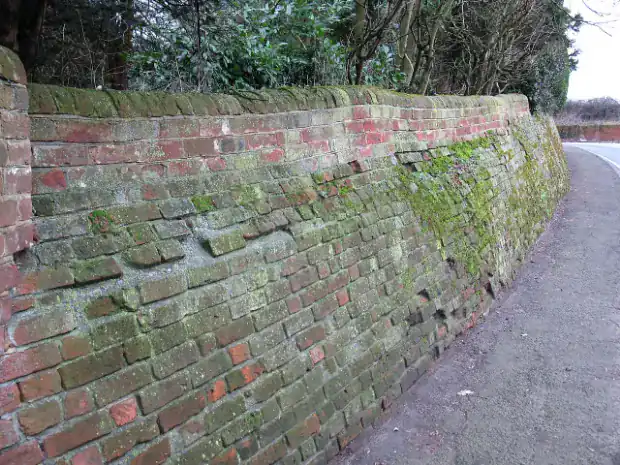

Block Walls vs Poured Concrete Walls
The wall material changes where the crack forms and how it behaves. Below I am sharing the differences in a table.
| Factor | Concrete block wall | Poured concrete wall |
|---|---|---|
| How common | The more common case | Less common |
| Where it forms | Along a mortar joint, often a few courses below the top | Across the wall, with no joint to follow |
| Why it forms | Mortar joints are weak in tension | Soil load, backfilling or a weak cold joint |
| Often seen with | Stair-step cracks near the corners | Diagonal cracks from the corners |
| Look-alike to rule out | A long mortar line with no real gap | A level pour line or form line |
As the table shows, a true horizontal crack in a poured wall is less common, so first rule out a pour line. In a block wall, a long crack along a joint with stair-step cracks at the corners is the classic pattern of a wall bending under soil pressure.
How to Measure a Horizontal Crack
Two numbers matter: the width of the crack and how far the wall has moved. Below I am sharing a simple way to record both.
- Measure the crack width: Use a crack card or ruler at the widest point and write it down.
- Check for bowing: Hang a plumb line from near the top of the wall, or stretch a string from corner to corner, then measure the gap at the point where the wall comes furthest in.
- Look for sliding: See whether the blocks above the crack sit further in than the blocks below it.
- Check the top of the wall: Look for gaps where the wall meets the framing above.
- Record the date: Mark the crack, take photos with a ruler in the frame, and repeat each season.
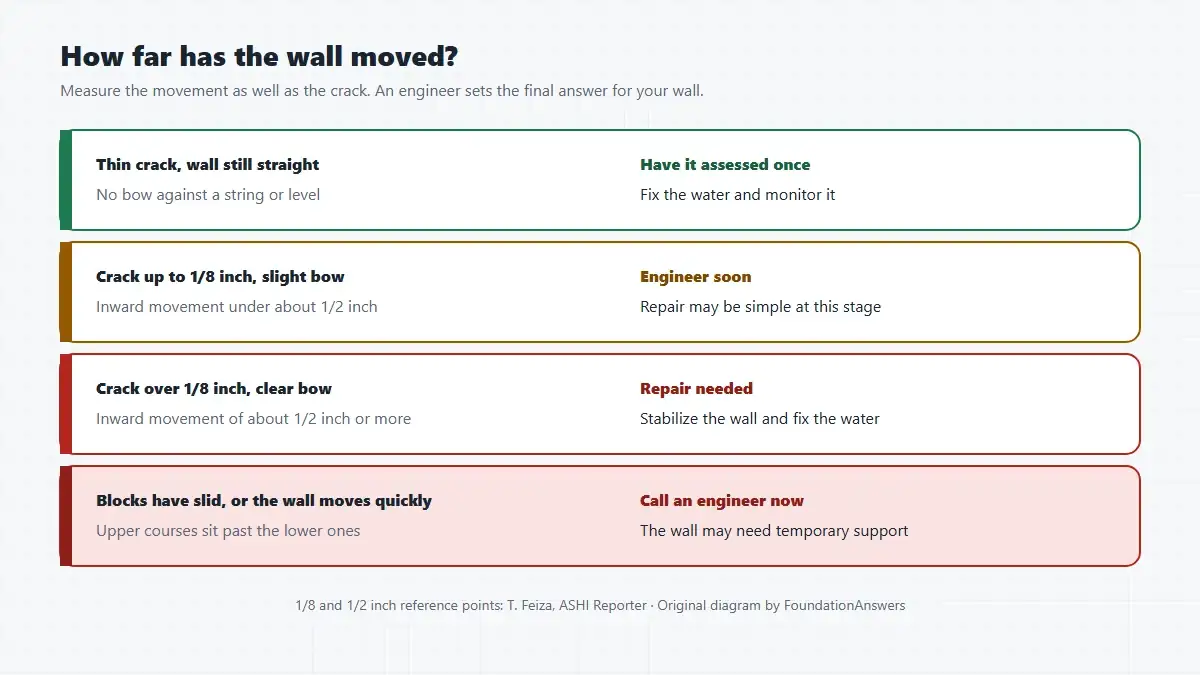
No building code sets a single limit for an existing wall. Tom Feiza, an engineer and home inspector writing for the American Society of Home Inspectors, treats inward movement over about 1/2 inch as potentially serious, and a horizontal crack wider than 1/8 inch with 1/2 inch or more of movement as needing repair. Our bowing basement wall guide covers the measuring method and the published limits in more detail.
Example: Suppose a string along your block wall shows a 3/8-inch gap at mid-height, with a 1/16-inch crack along a joint. That falls below the 1/2-inch reference point, so it is at an early stage. It still needs an engineer's opinion, and it is the best time to fix the drainage, because early movement usually costs the least to stabilize.
Example: Now suppose the gap is 1 inch and the crack is 1/4 inch wide. That is past both reference points, so plan on a structural repair as well as any sealing.
What Should You Do First?
You do not need to panic, but you should act in the right order. Below I am sharing the steps.
- Record it: Take dated photos and measurements before anything is patched or painted.
- Reduce the water: Clean the gutters, extend the downspouts and make the soil slope away from the wall.
- Remove loads: Keep vehicles, stacked materials and heavy equipment away from that wall.
- Clear the wall: Move stored items, so that an engineer can see it and you can spot any change.
- Book a structural engineer: Choose one who does not sell repairs, and ask for a written repair scope.
- Watch for fast change: If the crack widens quickly, blocks shift or the wall visibly leans, keep clear of it and call an engineer the same day.
How Much Does It Cost to Fix a Horizontal Crack?
The repair is for the wall, so the price depends on how far the wall has moved. Below I am sharing typical 2026 prices in a table.
| Repair | Best for | Typical cost |
|---|---|---|
| Carbon fiber straps | Small bows; holds the wall in place | $2,000–$5,000 |
| Wall anchors | Moderate bows, with open yard beside the wall | $3,000–$8,000 |
| Helical tiebacks | Moderate to severe bows, tight yards | $6,000–$12,000 |
| Excavate and straighten | Large bows the wall can survive | $8,000–$15,000+ |
| Wall replacement | Sheared or badly leaning walls | $15,000–$40,000+ |
As the table shows, the cost climbs with the movement, and that is the strongest reason to act early. Prices are from Modernize, updated August 2026. To build a budget, use this simple formula:
Total budget = engineer's inspection + water fix + wall repair + finishes
Example: Suppose your wall needs anchors. An engineer's inspection at about $600, regrading at $500 to $3,000 and anchors at $3,000 to $8,000 give a total of about $4,100 to $11,600, before you replace any finishes or landscaping.

Buying a House With a Horizontal Crack
This finding often appears in a buyer's inspection report, and it is a common reason deals stall. It is not an automatic no. Below I am sharing what to do during your inspection period.
- Book an engineer at once: You need the wall measured before your contingency ends.
- Ask about the history: Ask when the crack appeared and whether it has been patched, painted or braced.
- Look at any past repair: Straps or anchors should come with paperwork and, ideally, a transferable warranty.
- Talk to your lender: Loan rules can require structural defects to be repaired before closing.
Our guide to buying a house with foundation problems shows how to turn the repair estimate into a better price.
So, How Serious Is Your Horizontal Crack?
The answer depends on what your measurements show.
- If the line is perfectly straight with no real gap: Check that it is not a pour line or form line.
- If the crack is thin and the wall is straight: Fix the drainage, get a single assessment and keep measuring.
- If the wall has a slight bow: Book an engineer soon, because this is usually the cheapest stage to repair.
- If the movement is about 1/2 inch or more: Plan on a structural repair.
- If blocks have slid or the wall is moving quickly: Treat it as urgent and stay clear of the wall.
- If the crack is old and unchanged: Show the engineer your records, because a stable crack may need less work.
What You Should Do: Measure the wall this week, fix any water you can see, and have a structural engineer look at it before you agree to a repair.
Common Mistakes to Avoid With Horizontal Cracks
- Sealing and moving on: A sealant stops water and does not resist soil.
- Painting over it: Paint hides the evidence that shows whether the wall is moving.
- Waiting for it to get bigger: Early movement usually offers the cheapest repair options.
- Ignoring the drainage: A repair that leaves the wet soil in place leaves the load in place.
- Digging against the wall yourself: Removing soil unevenly can move a damaged wall.
- Letting a salesperson decide: Get the repair scope from someone who does not sell the product.
Conclusion
A horizontal crack in a basement wall usually means soil pressure is bending the wall, and that makes it the crack to take most seriously. Measure the crack and the bow, reduce the water and the loads, and have a structural engineer define the repair. Most walls caught early can be stabilized, and costs rise with movement, so it pays to act soon. For more help, browse our engineer-checked guidance on foundation wall warnings.
Frequently Asked Questions
-
Should I be worried about a horizontal crack in my basement wall?
Yes, enough to get it checked. NAHB lists horizontal basement wall cracks, especially with bowing or leaning, among the signs of a potential structural problem. Many walls have moved only slightly and can be stabilized for a few thousand dollars, so take it seriously without assuming the worst.
-
What causes a horizontal crack in a basement wall?
Sideways pressure from the soil outside is the usual cause. Wet soil, clay, frost and heavy loads next to the wall all push harder, and the wall bends between the floor framing at the top and the footing and slab at the bottom. Block walls are the most prone, because mortar joints are weak in tension.
-
How much does it cost to repair a horizontal foundation crack?
Repair depends on how far the wall has moved. Carbon fiber straps cost about $2,000 to $5,000, wall anchors $3,000 to $8,000, and helical tiebacks $6,000 to $12,000, according to Modernize. Excavating and straightening costs $8,000 to $15,000 or more, and replacing a wall can reach $15,000 to $40,000 or more.
-
Will a horizontal crack in a foundation get worse?
It can, because the soil keeps pushing and each wet season or frost adds pressure. Some cracks stay stable for years once the water is controlled, but you cannot know without measuring. Mark the crack, measure the wall with a string or level, and recheck it through the seasons.
-
Can I just seal a horizontal crack in a basement wall?
Not by itself. Sealing or injection can stop water but does nothing to resist the soil pressure that caused the crack. It can also hide further movement. Have the wall assessed first, stabilize it if needed, then seal the crack as a final step.
-
Should I buy a house with a horizontal crack in the basement wall?
You can, if a structural engineer defines the repair and the price reflects it. Have the wall measured before your inspection contingency ends, get quotes on the engineer's scope, and check that your lender will accept the condition. Walk away if the wall is moving and no one can define the repair.
Sources and Standards
- National Association of Home Builders, W. Keaveny, PE, Misconceptions about the common crack, January 2018.
- T. Feiza, American Society of Home Inspectors, Basement cracks and leaks, ASHI Reporter.
- Concrete Masonry and Hardscapes Association, TEK 15-01B, Allowable stress design of concrete masonry foundation walls.
- National Ready Mixed Concrete Association, CIP 7, Cracks in Residential Basement Walls.
- International Code Council, International Residential Code, Section R404, basement wall tables by soil class, as reproduced in state and county code documents.
- Modernize, Bowing basement wall repair cost, updated August 2026.
- This Old House, How much does a foundation inspection cost?, 2026.
- Fixr, Basement waterproofing cost, updated February 2026.
This guide is general information and does not replace an on-site inspection by a qualified professional. Read our disclaimer.