Cost guideBasement Water
French Drain Cost: 2026 Prices per Foot, by Type and Length
A French drain can cost $500 or $18,000. The type, length and what has to be dug up decide where you land, and some wet yards and basements need something cheaper first.
A French drain is a gravel-filled trench with a perforated pipe that collects groundwater or surface water and carries it away from your house. French drain cost usually comes down to three things: the type of drain, its length and what must be dug up to install it. This guide is part of our basement water hub, which explains why water gets in and how to stop it.
If your lawn stays soggy after every storm or water creeps across your basement floor, you are not alone in wondering what a proper fix costs. Prices online swing from a few hundred dollars to five figures, and that makes it hard to judge a quote. In this guide I will explain what a French drain costs per foot, what the total is for common lengths, what raises the price, how to work out your own budget, and when a cheaper fix will do the job.
Short answer
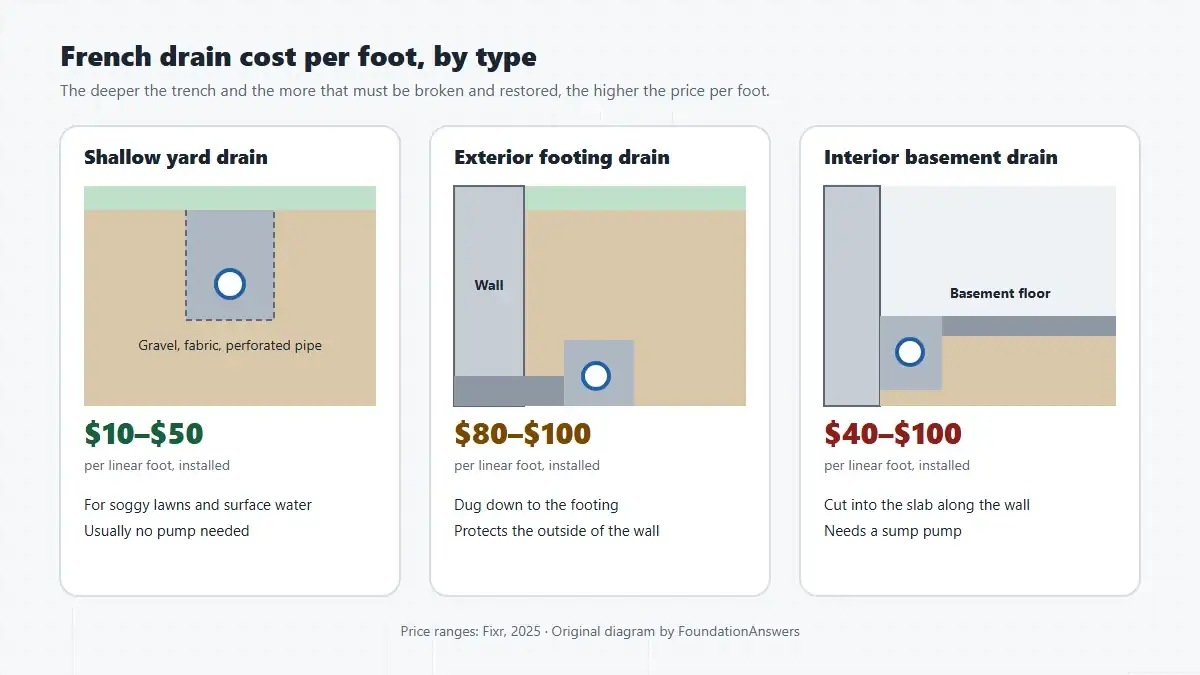
A French drain costs about $5,000 on average, with most projects between $2,800 and $6,500 according to Fixr. Exterior drains cost $10 to $100 per linear foot and interior basement drains cost $40 to $100 per foot. For 100 feet, expect about $3,500 to $4,000 outside and $5,000 to $6,000 inside, plus $500 to $4,000 for a sump pump if you need one.
Lowest cost
Shallow yard drain
$10 to $50 per foot. Open ground, no slab to cut and often no pump.
Mid cost
Interior basement drain
$40 to $100 per foot, plus a sump pump and new concrete.
Highest cost
Exterior footing drain
$80 to $100 per foot. Dug down to the footing, then restored.
How Much Does a French Drain Cost per Foot?
The price per foot depends mostly on the type of drain. Below I am sharing typical installed prices in a table.
| Drain type | Cost per foot | Best for |
|---|---|---|
| Shallow exterior drain | $10–$50 | Soggy yards and surface water |
| Exterior footing drain | $80–$100 | Water reaching the foundation wall |
| Interior basement drain | $40–$100 | Water at the joint of the wall and floor |
As the table shows, a shallow yard drain is the cheapest because it needs only a modest trench in open ground. Modernize gives a similar outdoor range of $10 to $65 per foot. A footing drain costs the most per foot because the trench goes down to the base of the wall, and an interior drain falls in between because a crew must cut and replace the concrete floor.
French Drain Cost by Length
Length is the easiest way to estimate your total. Below I am sharing Fixr's installed prices for common lengths in a table.
| Length | Exterior | Interior |
|---|---|---|
| 50 feet | $1,250–$2,000 | $2,500–$3,000 |
| 100 feet | $3,500–$4,000 | $5,000–$6,000 |
| 150 feet | $4,250–$5,000 | $7,500–$9,000 |
As the table shows, interior drains cost roughly one and a half to two times as much as exterior drains of the same length. Across all projects, LawnStarter reports that most homeowners pay $1,650 to $12,250, and Fixr gives a low of $500 and a high of $18,000 for the rare very small and very large jobs.
French Drain Cost by Location
Where the drain runs matters as much as how long it is. Below I am sharing Fixr's prices by location in a table.
| Location | Cost per foot |
|---|---|
| Yard | $20–$30 |
| Crawl space | $25–$35 |
| Around a patio | $25–$40 |
| Along a retaining wall | $25–$50 |
| Under a sidewalk | $30–$50 |
| Under a deck | $35–$45 |
| Along a driveway | $45–$55 |
| In a garage | $50–$60 |
| Around the house | $50–$80 |
| In a basement | $60–$70 |
As the table shows, open ground is cheap and anything that must be broken up costs more. Tight access has the same effect, because a crew digging by hand costs more than a small trencher.

What Affects French Drain Cost?
Two quotes for the same length can differ for good reasons. Below I am sharing the factors that move the price most.
- Depth: A deeper trench means more excavation, additional gravel and more soil to remove from the property.
- Access: LawnStarter notes that limited access for a trencher or mini-excavator raises labor costs.
- Soil: Rock, tree roots and heavy clay slow the excavation, which increases the labor charge on the invoice.
- Surfaces in the way: Driveways, patios, walkways and slabs must be cut and replaced.
- Sump pump: Modernize puts a sump pump system at $500 to $4,000, depending on the pump and installation.
- Where the water goes: A long run to a safe outlet adds pipe, and a pumped outlet adds power and upkeep.
- Materials: Fixr lists 4-inch perforated pipe at $1 to $1.50 per foot, and Modernize lists gravel at $10 to $60 per cubic yard.
- Restoration: Modernize lists sod at $0.30 to $0.80 per square foot. Ask if the quote includes it.
How to Estimate Your French Drain Cost
You can build a rough budget before you call anyone. Use this simple formula:
Total cost = length in feet × price per foot + sump pump + restoration
Example: Suppose your lawn stays wet along a 60-foot side yard with open access. At Fixr's yard rate of $20 to $30 per foot, the drain costs about $1,200 to $1,800, with no pump needed.
Example: Now suppose your basement leaks along 120 feet of wall. At $60 to $70 per foot, the interior drain costs about $7,200 to $8,400. A sump pump at $500 to $4,000 brings the total to about $7,700 to $12,400. If the pump and new concrete are already in the quote, do not add them twice.
Do You Need a French Drain?
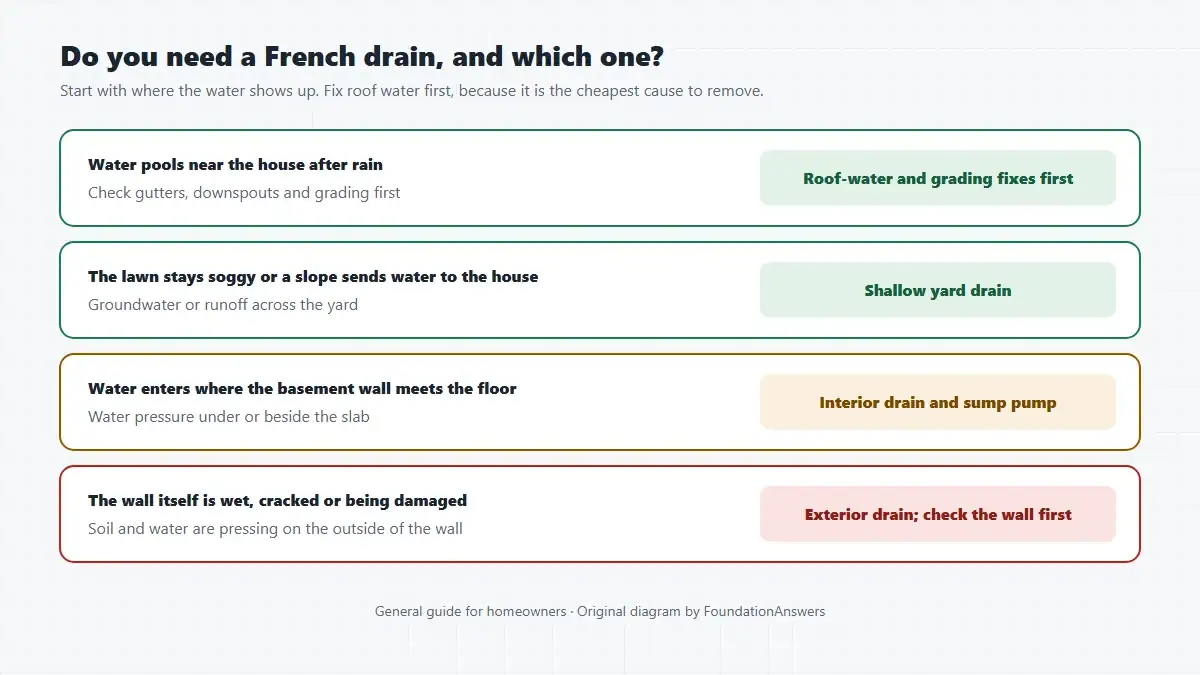
A French drain moves water that is already in the soil. It does nothing for water you could stop from getting there. Below I am sharing the cheaper checks to make first.
- Gutters: Clean them and repair any leaks, so that roof water is not concentrated beside the foundation wall.
- Downspouts: Extend them several feet away from the foundation, especially at the corners of the house.
- Grading: Reshape the surrounding soil so that the ground slopes away from the house in every direction.
- Plumbing: Rule out a leaking supply or drainage pipe if water appears during dry weather.
If water still gets in, a drain is a sensible next step. A leak through the wall itself may need different work, and our guide to basement waterproofing cost compares every option.
How a Proper French Drain Is Built
Knowing the build helps you read a quote, because a drain is buried and you cannot check it later. Below I am sharing what good work looks like.
- Slope: Installation guides commonly call for a fall of about 1%, or about 1 inch every 8 feet, so that gravity moves the water.
- Filter fabric: Fabric keeps soil out of the gravel. Without it, the drain can clog.
- Clean gravel: Washed stone without fine particles allows water to travel easily toward the pipe.
- Perforated pipe: The pipe carries the collected water away considerably faster than gravel alone.
- A safe outlet: The water must end up somewhere lower and legal, such as a daylight outlet or a sump pit, and never on a neighbor's land.
- Cleanouts: Accessible connection points make it possible to inspect and flush the pipe in later years.
For foundation drains, building code sets minimums. IRC Section R405.1 in its 2003 text calls for drain pipe to sit on at least 2 inches of washed gravel and to be covered by at least 6 inches of the same material. Gravel drains must reach 1 foot beyond the footing and 6 inches above it, under a filter membrane. Your local adopted code may differ, so ask your building department.

Can You Install a French Drain Yourself?
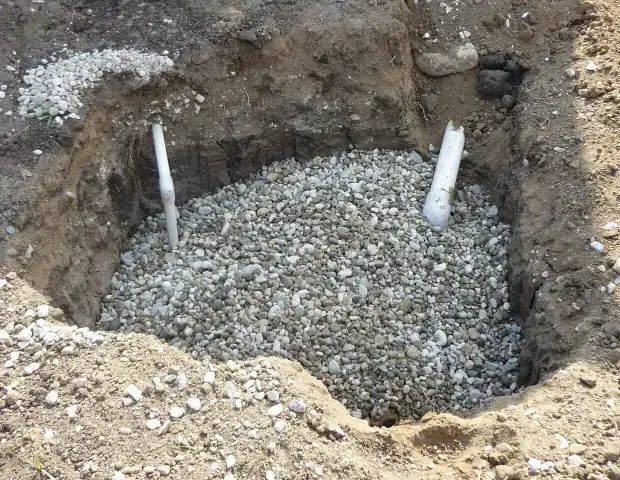
A short shallow yard drain is a reasonable project for a capable homeowner. Fixr's pipe prices and Modernize's gravel prices show that materials are a small part of the bill, and that labor makes up the larger share. Below I am sharing what to weigh.
- Good for DIY: A short yard drain in soft soil with an easy outlet.
- Leave to a pro: Interior drains, footing drains and anything that needs slab cutting or a deep trench, because deep trenches can collapse.
- Before any digging: Call 811 to have buried utility lines marked.
Benefits and Possible Drawbacks of a French Drain
Below I am sharing the benefits first.
- Moves water away: It intercepts groundwater and surface runoff that gutters and downspouts cannot control.
- Lower pressure on walls: Less water in the surrounding soil means less hydrostatic pressure on a foundation wall.
- Mostly hidden: Once it is buried, the system needs only occasional inspection and flushing.
Below I am sharing the possible drawbacks.
- Disruption: Trenches temporarily damage lawns and landscaping, and interior installation produces considerable dust and noise.
- Clogging: Fine silt can gradually block the gravel and pipe over time, particularly without filter fabric.
- Pump upkeep: Interior systems depend on a sump pump, which needs power and care. Our sump pump troubleshooting guide shows what can go wrong.
- Repair cost: Fixr puts repairs at $1,000 to $2,500, and a full replacement at $2,000 to $8,000.
So, Is a French Drain Worth It?
The answer depends on your water problem.
- If your yard stays soggy for days after rain: Yes. A shallow drain is usually good value.
- If water enters at the joint of the basement wall and floor: Yes. An interior drain and sump pump is a common fix.
- If water pools only below a downspout: No. Fix the gutters and downspouts first.
- If the wall is cracked or bowing: Not yet. Have the wall checked before you spend money on drainage.
- If you are finishing the basement: Usually yes, because it is far cheaper to add a drain before the walls and floors go in.
What You Should Do: Watch where the water appears during a storm, fix roof water first, then get quotes for the type of drain that matches the problem.
Common Mistakes to Avoid With French Drains
- Skipping the cheap fixes: A trench cannot make up for a short downspout.
- Comparing totals only: Check depth, length, pump and restoration. Our repair quote checklist shows how.
- No outlet plan: A drain without a suitable discharge point simply stores water in the ground.
- Leaving out filter fabric: Surrounding soil gradually migrates into the stone and blocks the drainage path.
- Laying pipe with no slope: Water remains inside the pipe instead of flowing toward the outlet.
- Sending water to a neighbor: It can cause a dispute and may break local rules.
- Digging before calling 811: Hitting a buried electric or gas line is dangerous and expensive.
Conclusion
A French drain costs about $5,000 on average, with exterior drains at $10 to $100 per foot and interior drains at $40 to $100 per foot. Length, depth, access, a sump pump and restoration decide your total. Fix gutters, downspouts and grading first, match the drain to where the water appears, and compare quotes on the same scope. For more help, browse our engineer-checked cost guides for wet basements and yards.
Frequently Asked Questions
-
How much does 100 feet of French drain cost?
Fixr puts 100 feet at about $3,500 to $4,000 outside and $5,000 to $6,000 inside a basement. Modernize gives a wider $1,000 to $6,500 for 100 feet of outdoor drain, depending on soil, depth and access. Add the cost of a sump pump if the drain needs one.
-
How much does a 200 ft French drain cost?
Using published per-foot prices, 200 feet of outdoor drain works out to about $2,000 to $13,000 at $10 to $65 per foot. Inside a basement, $40 to $100 per foot gives about $8,000 to $20,000. Long runs often earn a lower rate per foot, so get a quote for your exact length.
-
Is a French drain expensive?
It depends on the type. A short shallow drain in an open yard can cost a few hundred to a few thousand dollars. An interior basement system needs the slab cut, a sump pump and new concrete, so it costs several thousand. Fixr's national average is about $5,000.
-
Are French drains worth the money?
They are worth it when groundwater or runoff is really the problem. They are not worth it when clogged gutters, short downspouts or poor grading are sending the water to the house, because those fixes cost far less. Find the water source before you pay for a trench.
-
Do I need a permit for a French drain?
Often not for a simple yard drain, but rules vary by location, so ask your building department. Interior work, connections to a storm drain and work near a property line are more likely to need approval. Call 811 before anyone digs, and never send the water onto a neighbor's land.
-
How long does a French drain last?
There is no fixed lifespan, because it depends on the soil, the fabric and the installation. Silt can clog the gravel and pipe over time. Fixr lists signs of failure such as standing water or water flowing over the pipe, with repairs at $1,000 to $2,500 and full replacement at $2,000 to $8,000.
Sources and Standards
- Fixr, French drain installation cost, updated January 31, 2025.
- LawnStarter, How much does a French drain cost?, updated October 5, 2026.
- Modernize, French drain cost, updated August 12, 2026.
- International Code Council, International Residential Code Section R405.1, 2003 text, as reproduced by Winnebago County, Illinois.
- Jaspector, French drains: design, installation and common mistakes.
This guide is general information and does not replace an on-site inspection by a qualified professional. Read our disclaimer.